
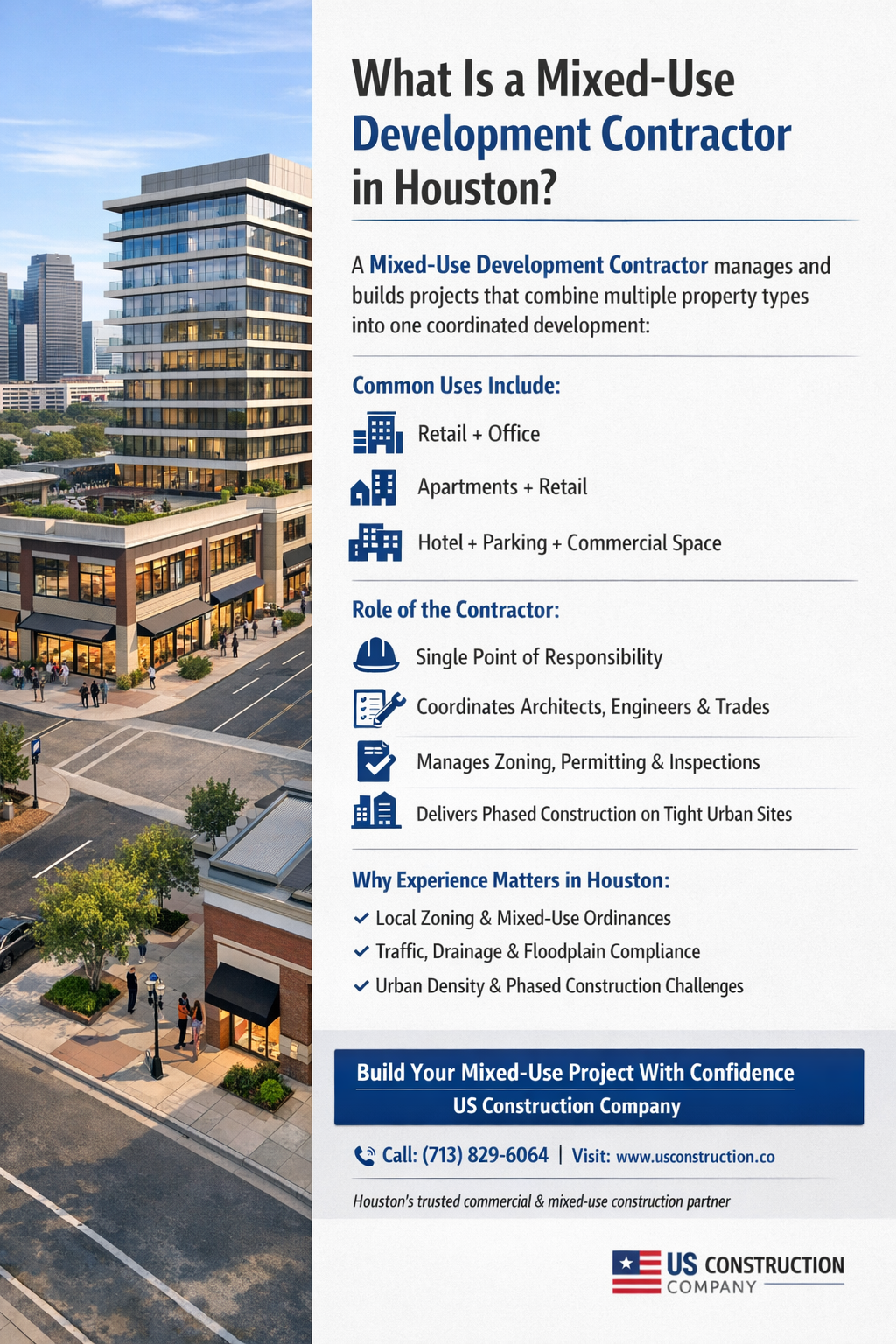
With the rapid growth of the urban population, the trend towards mixed-use development is increasing. In such structures, residential, retail, workspaces, and public or shared amenities are constructed in a single unit. For a more precise understanding, explore with us what is a mixed-use development contractor in Houston.
US Construction Company manages complex construction projects and regulatory compliance across multiple property types under a single contract. Our experts successfully protect the budgets, timelines, and long-term value of mixed-use development assets. This post provides a comprehensive overview of how mixed-use developments integrate diverse building systems and comply with regulatory requirements.
What is a Mixed-Use Development?
A multistory building that accommodates living, working, shopping, and leisure spaces under one roof instead of separate locations. This ideal is suitable for overpopulated urban areas, maximizing land use while enhancing property value in the long term.
Houston’s flexible zoning laws support the trend toward mixed-use development in Downtown, Midtown, the Galleria, and the Energy Corridor. Common mixed-use building combinations are:
| Residential + Retail | Residential apartments on upper floors with shops and food points on the first floor. |
| Office + Parking | Commercial-use buildings with advanced automated parking garages. |
| Hospitality + Retail | High-rise buildings have hotel rooms and a for restaurants, cafés and shopping centers. |
| Residential + Office + Retail | Full-scale mixed-use developments support living, working, and entertainment. |
The basic understanding of single-use and mixed-use constructions varies in terms of their design complication and long-term functionality.
Single-Use Developments
When a building is constructed from the groundwork to the final finish for a single intended use, it may be a residential apartment, a standalone retail store, or an office condo. The simple basic purpose of construction makes its design, structural systems, and regulatory codes one coherent approach.
Mixed-Use Developments
When a single structure is designed to accommodate various uses. It requires more advanced mechanical, structural, and accessibility requirements, as well as compliance with safety features. Mixed-use developments are tricky to plan, permit, and execute because they involve multiple building codes.
Role of a Mixed-Use Development Contractor
A mixed-use development contractor in Houston, Texas, is an experienced professional capable of handling complex construction projects. They have a competent team for effective coordination and the technical resources to handle a multi functional project.
Mixed-use projects require thorough planning, close collaborations, and hands-on experience across diverse building types and occupancies.
Planning and Feasibility Studies
Experienced contractors understand the local climate and land use practices. They effectively evaluate constructability, accurate budgets, realistic schedules, and possible risks. Mixed-use construction companies carefully analyze design features, identify cost drivers, and integrate phasing strategies.
Before construction operations, a practical understanding of existing utility connections, floodplain considerations, and code requirements protects from costly mistakes.
Effective Professional Coordination
Mixed-use buildings are complicated in terms of their structural elements, MEP systems, and safety measures. These structures required diverse approaches to accommodate housing, office, retail, hospitality, and parking needs. Only experienced, specialized developers can integrate these overlapping demands to deliver a single functional unit.
Managing Different Subcontractors
Contractors have to deal with different materials and fixtures suppliers on their own convenient timelines. For instance, in a mixed-use plaza, the first floor requires fixtures of commercial use with long-term durability. For residential floors, they need customized fixtures and materials to attract tenants. They manage multiple trades and logistics requirements simultaneously without delays or conflicts.
Quality Control and Safety Management
When diverse construction types are managed in a single unit, delivering consistent quality is quite challenging. Reliable builders develop a standard inspection protocol, testing parameters, and record-keeping methods for quality control.
Mixed-use developments are common in densely populated areas with high pedestrian and vehicular traffic. Professionals need to implement strict safety codes to protect workers, tenants, and the public.
Overall, a qualified general contractor in Houston is effective in complex mixed-use developments. They have a single point of accountability and collaborate to deliver precise planning, budgeting, and management.
Why Mixed-Use Projects Are Complex in Houston
Mixed-use constructions are inherently challenging. When contractors deal with clay-rich soil and unpredictable weather in Houston, it adds another layer of complexity. Experienced construction companies allocate significant time to site analysis and design testing to identify issues at the earliest stages.
Houston Zoning and Land-Use Laws
There is no strict zoning enforcement in Houston, which gives developers some flexibility. However, they must comply with land-use ordinances, deed restrictions, parking minimums, and compatibility standards.
Mixed-use projects fall under multiple regulatory codes due to their diverse occupancy types and land-use practices. Thus, the contractors require more time and effort to achieve NOC and approvals for these projects.
Soil and Drainage Conditions
The flat topography of Houston, combined with heavy rainfall, makes stormwater management more challenging. Moreover, in construction, professionals face challenges installing an effective drainage system and waterproofing structural components.
Mixed-use buildings require extensive detention systems, elevated foundation work, and synchronization with city drainage regulations. Mixed-use development builders should understand Houston’s soil chemistry and water table to support long-term asset value.
Diverse Utility Coordination
The demand for electrical power supply, sewage pipes, and HVAC systems differs between residential, commercial, and hospitality construction. In mixed-use developments, contractors must fulfil diverse utility needs within a tight urban footprint. They have to carefully plan design features with phased tie-ins to avoid service conflicts or capacity issues.
Phased Construction in Urban Area
Mixed-use construction is more common in densely populated urban areas. The developer needs to schedule their activities for minimal disturbance to surrounding businesses, roads, or buildings. Implementing noise control practices, traffic control, and planned logistic routes for safe operations.
Types of Mixed-Use Developments Built in Houston
Houston’s booming industrial sector is attracting more people to support economic activity. Urban sprawl requires infrastructure to accommodate the additional workforce. In such a scenario, the mixed-use building trend, with varying specifications and design features, meets the needs of various users.
Urban Mixed-Use Complexes
Mixed-use constructions in a high-density urban zone, including Downtown, Midtown, and the Galleria. These projects require more secure planning and execution for limited-access sites. Moreover, the developers have to handle the complexity of existing utility supplies, structural systems, life-safety codes, and phased construction.
Suburban Lifestyle Centers
The surrounding areas of Houston experienced mixed-use constructions with flexible tenant spaces and efficient site circulation. There, the space is considerably more than the urban zone, and builders focus on retail, restaurant, office, and residential developments. The emphasis is on modern amenities with a fully connected environment.
Transit-Oriented Developments (TODs)
The transportation system is the backbone of economic activities. The mixed-use development projects focus on METRO Rail stations and other transit corridors. To manage construction in higher-density areas, professionals introduce automated, compact parking garages.
High-Rise Mixed-Use Towers
Sky rise buildings that stack multiple occupancies integrate value engineering, vertical MEP distribution systems, and high-capacity life-safety installations. The standard structure is retail on the basement floor, offices on the first floor, and apartments on the upper floors.
Retail and Residential Podium Projects
In such projects, residential units with retail and ample parking are in high demand across Houston. Contractors manage proper design features for effective load distribution, sound mitigation, and code compliance. These use cases demonstrate the technical depth and versatility of mixed-use developments.
Common Challenges in Mixed-Use Construction
The construction industry in Houston is growing exponentially. However, the complexities of supply logistics and labor availability affect project timelines and costs. Mixed-use developments involve unique technical, logistical, and regulatory challenges. Experienced Houston general contractors apply proven strategies to address issues early.
Managing Multiple Occupancy Codes
To protect the interests of multiple users, contractors must follow residential, commercial, and public-sector standards. The need for fire safety, emergency exits, accessibility, and building codes differs from that of single-use construction. They collaborate with all stakeholders to detect concerns and document comprehensive compliance strategies.
Complex Scheduling and Coordination
The collaborative efforts of subcontractors require precise sequencing to accommodate overlapping scopes for retail, living, and working. Houston commercial builders integrate detailed schedules with separate work plans for each trade. For a consistent workflow, regular coordination meetings prevent delays.
Integrating Different MEP Systems
In a single utility connection, meeting diverse users’ requirements requires strategic planning and management. Shared infrastructures for electric cabling, sewerage pipes, and HVAC systems involve innovative installation methodologies.
Site Logistics in Tight Urban Zones
The project timelines are affected by working in densely crowded areas with heavy traffic congestion and by nearby occupied properties. Contractors mitigate these concerns through clear communication with subcontractors and the local community. They implement traffic control plans and on-demand delivery of construction materials.
Cost Control Across Diverse Scopes
Precise budgeting is challenging when multiple building types are involved. Professionals keep regular monitoring of progress and expenditures to reduce cost overrun. Moreover, practical project assessments and transparent procedures for order change keep operations within the allocated budget.
Quality Consistency
The interior finishes for residential and office spaces have different standards and performance parameters. Mixed-use development contractors in Houston, TX, understand such distinctive criteria. They involve standardized quality control processes and testing methods to ensure consistent artistry across all areas.
Safety Risks on Multi-Phase Sites
When multiple trades are involved at a single site, the risk of safety concerns increases. Developers enforce specific measures and access controls. Regular safety audits are mandatory to protect workers and nearby tenants.
Design-Build vs. Traditional Delivery for Mixed-Use Projects
In mixed-use developments, selecting an appropriate project delivery method secures your investment and the property’s long-term value. Here, we explore two types of approaches based on project budget, timelines, and managerial demands.
Design-Build (Single Point of Responsibility)
When a proper owner wants a construction company that starts from scratch till the final finish. In this approach, the contractor is responsible for initial planning and design to obtain local authority approval.
Design-build is suitable for complicated projects with short timelines and unclear scopes. When experts are involved at the initial stages, they identify issues earlier, before they become costly repairs.
| Pros | Cons |
|
|
Traditional Design–Bid–Build (Separate Contracts)
In this approach, the property owner finalized the construction design with the help of a designer. Afterward, they publicize their project, invite bids, and hire a contractor through competitive bidding.
| Pros | Cons |
|
|
The design-build approach is optimal for mixed-use development projects to secure your investment and faster completions. The traditional method offers greater design and cost flexibility but is associated with a higher risk of coordination.
Mixed-Use Development Contractor in Houston
In overpopulated urban areas, mixed-use buildings offer convenience and a budget-friendly option. Moreover, it accommodates more tenants and businesses than a single-use structure, thereby maximizing land utilization. A specialized Houston general contractor with a track record of handling mixed-use construction delivers a better return on investment.
A US Construction Company involved disciplined planning and effective coordination to deliver complex projects on time and within budget. Contact us for successful, durable, and profitable mixed-use development.
FAQs
Q1. What is the average timeframe for a mixed-use project?
The average timeframe depends on the project size, height, and complexity. Small-scale mixed-use construction requires 12 to 18 months; however, a multi-story building may take 24–36 months. Indeed, the site conditions, permitting requirements, and local weather impact the project timelines.
Q 2. Can a phased construction approach be applied in mixed-use developments?
In phase construction, the activities are managed to minimize their impact on nearby tenants or business operations. Mixed-use developments are often preferred in urban areas with congested work areas. Phase construction enables developers to begin operations without disrupting neighboring communities.
Q 3. Is a mixed-use construction more costly than single-use development?
Mixed-use projects are often expensive due to complicated design features, advanced MEP systems, and regulatory obligations. However, such constructions offer higher land-use efficiency, a reasonable market selling price, and multiple buyers.
Q 4. Do mixed-use development projects in Houston require a permit?
Yes, mixed-use developments require approvals from local authorities and regular site inspections to ensure conformity. Contractors must comply with Houston building codes, zoning requirements, fire protection standards, and safety certifications.
Leave A Comment