

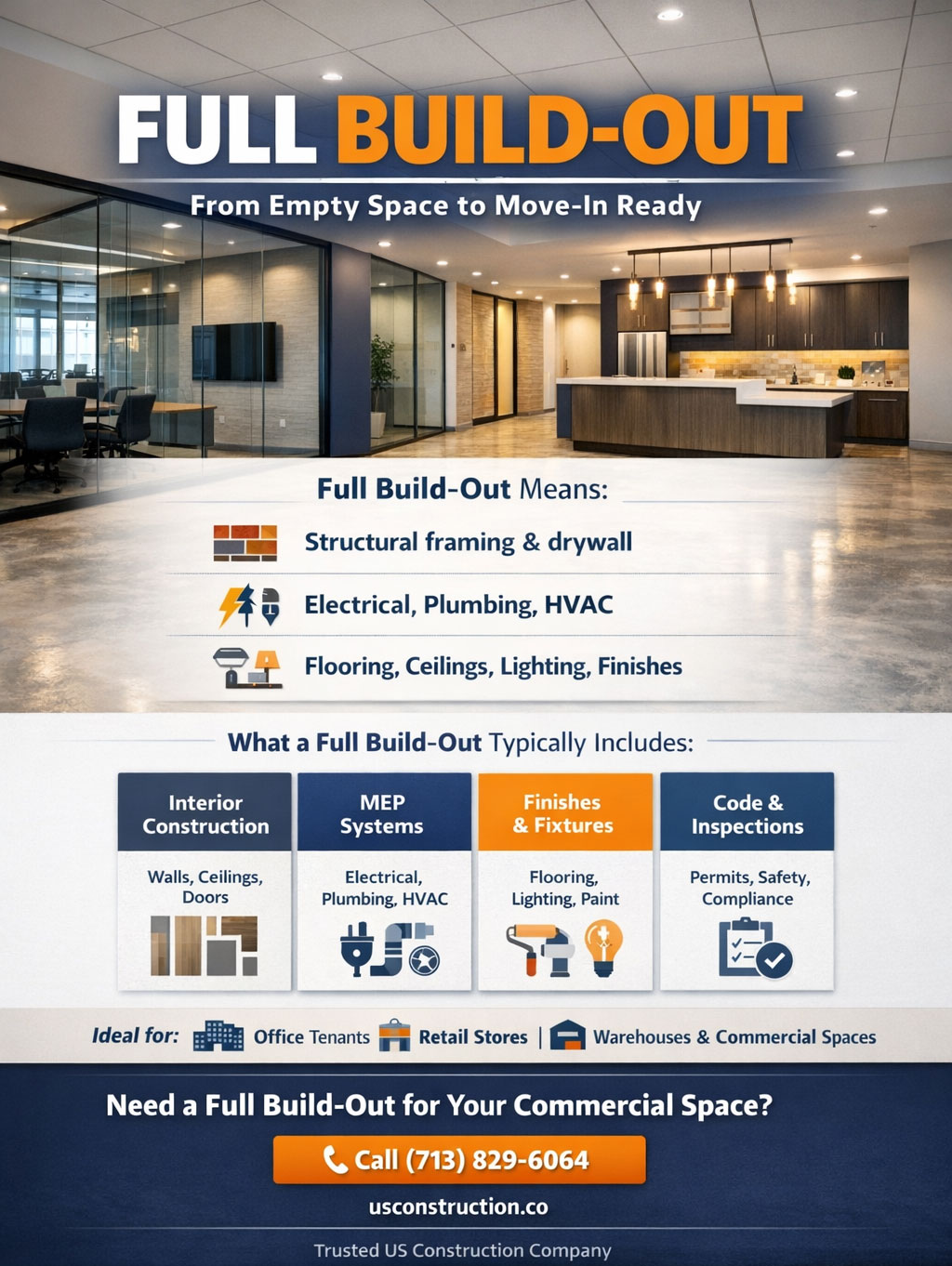
When you need a customized structure for your home or office, from a bare shell to fully built out, full-built-out is the only solution. Contractors manage finishing and minor construction work to turn the empty building into a fully functional, ready-to-use environment. For a more in-depth understanding, explore with us what a full build-out means in general construction.
It is commonly used for final finishing, interiors, systems, and layouts in commercial construction. US Construction Company understands the full build-out needs of property owners, tenants, and developers. We consider your budget, timelines, practical uses, compliance, and long-term value.
What is Full Build-Out Construction?
In the commercial and real estate business, owners purchase the building in a gray structure and hire contractors for build-out services according to their needs. It covers architectural, structural, mechanical, electrical, and plumbing work.
When you want to cover a complete customization from a bare shell to a move-in-ready construction, it requires a full build-out. It starts from scratch and finishes. However, for upgrades to selected sections or systems involved, the work falls under partial build-out.
What Is Included in a Full Build-Out?
In the commercial sector, owners mostly purchase buildings with concrete floors and load-bearing pillars. They require complete finishing services to make it usable and compliant with regulatory codes. The extent of complete build-out varies with customers’ needs. So, they should have a comprehensive and clearly defined project scope.
Structural and Base Building Elements
This process starts with the development of the fundamental physical structure of the interior space. Houston’s full build-out general contractor finalizes the design to meet tenant requirements. The structural elements include:
- Developing interior walls and ceilings.
- Installing windows, doors, and partitions.
- Dry plaster on the walls and flooring.
These elements define the building’s basic layout and include load-bearing walls and non-load-bearing partitions.
MEP Systems (Mechanical, Electrical, Plumbing)
The installation of electrical, sewerage, and other mechanical components is a critical step. Reliable professionals understand the needs of different users and work effectively with them. The key systems are:
- HVAC systems for proper ventilation and temperature control.
- Installing power outlets and electric wiring.
- Integrate emergency lighting
- Plumbing and sewerage supplies.
- Washrooms and kitchen fixtures.
- Fire protection systems.
Regular codes for MEP systems vary by construction type. Commercial and industrial complete build-outs require stricter compliance with safety features.
Interior Finishes
Retail stores or brand outlets require unique interior finishes representing their brand identity. Likewise, the office environment needs relaxing and cozy interior surfaces. Experienced general contractor in Houston provides:
- Interior walls, coatings, and floor finishing.
- Mill work, casework, and built-in features
- Glazing of windows and doors.
- Ceiling systems and acoustic treatments
In fact, in interior finishing, the final look and feel of the construction are completed. The project’s budget impacts the visual and functional quality of the space.
Code, Safety, and Compliance
In Houston, the building codes are clearly defined for residential, commercial, and industrial constructions. In build-out services, contractors integrate the owner’s needs with local regular standards. The basic structure should follow:
- ADA accessibility law.
- Fire safety, emergency exits, and proper signage.
- Compliance with Houston-specific codes.
- Official audits and inspections.
Meeting these regulatory requirements is essential for NOC approval and final occupancy.
Full Build-Out vs. Tenant Improvement (TI): Key Differences
In commercial construction, the owner should have a complete understanding of the build-out and tenant improvements. Indeed, these two look similar but differ in scope. Overview of the significant differences.
Tenant Improvements (TI)
In such modifications, the building’s existing structures are upgraded to meet the new tenant’s needs. It does not cover the entire rebuilding of the load-bearing structures. Tenant improvements usually cover cosmetic or layout-based installations.
Cost and Responsibility Differences
Well, the complete build-outs involve significant changes in structural elements, MEP systems, and code compliance. So, the cost is definitely higher than tenant improvements. All expenses are borne by the property owner or tenant as defined in the leasing agreement.
On the other hand, TI is a less expensive service that typically focus on final finishing, minor portions, and small system upgrades. Landlords are responsible for basic allowances; however, for additional upgrades, tenants are compelled to share.
When a full build-out is required
There are some cases when tenant improvements are converted to complete build-outs, including:
- When the space is a bare shell
- Existing building does not fulfill the operational needs of the tenant.
- A use change is required.
Understanding the renovation requires enables the selection of a suitable option. Other factors include your budgets, timelines, and the space’s long-term usability.
Full Build-Out in Different Construction Sectors in Houston
A full build-out differs across residential, commercial, and industrial settings, given their uses and regulatory requirements. Here, we explore some use cases in the construction sector where build-out is necessary. The scope of build-out is defined by its future functional needs.
Commercial Office Spaces
Commonly, in working spaces, a full build-out is required to convert a gray structure into a customized office. The nature of business and daily operations changes the scope and budget of each project. Corporations or entrepreneurs cover these features:
- Private offices, shared spaces, open-layout offices.
- Conference or seminar rooms.
- Networking or unique IT infrastructure.
- Custom lighting, acoustics control, and upgraded HVAC.
The goal of such build-outs is to create a workspace that is comfortable for employees, boosting productivity and collaboration. Houston commercial contractors provide personalized build-out services tailored to your business needs and budget.
Retail Build-Outs
Retail build-outs require buildings that enhance customer experience, branding, and public appeal. Contractors focus on aesthetic and functionality factors to fulfill their operational requirements.
- Storefront development with personalized interior layouts
- Point-of-sale section with ample space for back storage.
- Lighting and finishes enhancing brand credibility.
The design features should improve product display and smooth customer flow.
Industrial and Warehouse Facilities
The large-scale, intensive operations of industries and manufacturing units require robust functionality. Moreover, the build-out procedures should strictly follow regulatory codes.
- Display section connected with the warehouse
- High-capacity electric wiring and power supply.
- Slip-free and durable flooring without compromising appearance.
- Proper lighting and ventilation.
The construction layouts should be open and high-load tolerant to support the transportation of heavy equipment and extensive use.
Medical and Specialized Facilities
Healthcare centers and hospitals require unique features and structural elements to facilitate patient care and the care of their attendants. Moreover, the safety and hygienic requirements are strict.
- Compliance with medical and safety regulations
- Specialized HVAC and ventilation systems
- High-power cabling to withstand heavy equipment installations.
These build-outs need to hire specialized Houston general contractors with previous work experience in this sector.
Complete Build-Out Process: Step-by-Step Overview
A full build-out is a strategically planned and carefully executed approach to keep budget and timeline control. Here, we explore its basic phases to help readers make a wise decision.
Design and Planning
For successful build-outs, developers collaborate with architects and designers to finalize designs that meet tenants’ requirements and comply with regional codes. They structure walls, systems, and finishes that meet the modern aesthetics and functionality.
Permitting and Approvals
As this process involves modifications and upgrades to load-bearing structures, permitting must be obtained before work begins. The contractors have approved their design with local authorities and received no objection certificates.
Demolition (if required)
If the existing interiors require removal to renovate, follow the Houston building demolition codes. Partial demotion is quite tricky and requires personalized equipment and professional expertise.
Core Construction and MEP Rough-Ins
The mechanical systems and plumbing work are completed before final finishing. Experts install electrical cables and sewerage pipelines in the initial phase.
Interior Finishes and Installations
After the central structural installation, flooring, ceilings, lighting, fixtures, and mill work are completed. It gives the building a final look.
Final Inspections
Obviously, to comply with regional codes, contractors have to clear the third-party inspections. These assessments verify the structural integrity and code compliance of the build-out work.
How Long Does a Full Build-Out Take?
The timeline for a full build-out varies with the scale of the project and connected complications. The primary cause of delays in build-outs is the availability of labor and materials. Moreover, Houston construction regulations and the permit receipt process take considerable time. Some basic project timelines are
| Small commercial build-outs | 8–12 weeks |
| Mid-scale retail stores or office | 3–5 months |
| Large-scale complicated build-outs | 6 months or longer |
In commercial build-outs, repeated revisions in the design phase increase project costs and timelines. Precise planning and team collaboration are essential to keep timelines on track.
What Factor Influences Full Build-Out Cost?
Full build-out costs are calculated per square foot and vary with project scope and tenant requirements. More customized spaces increase costs and complexity, from basic to high-end, depending on finishes and systems. The key cost drivers are:
- Labor expenses and shortage of skilled trades.
- Quality of materials used.
- Architectural and engineering design fees.
- Demolition of sensitive elements.
- Complicated installations of MEP systems.
- Building codes and zoning laws restrictions.
Urban build-out projects are costly due to higher labor and permit expenses. Moreover, repeated design changes affect costs and timeframes.
Common Mistakes to Avoid in a Full Build-Out
A full build-out is a significant investment that impacts your daily operations, safety, and the long-term value of your property. Experienced contractors reduce the chances of mistakes and keep your project on schedule, compliant, and within budget.
Inadequate Planning
Build-outs require comprehensive planning and design consideration for a reliable structure. Contractors place primary focus on pre-construction drawings, scope definition, and transparent budgeting. Poor evaluations can lead to redesigns, change orders, and permit issues.
Ignoring Permitting Requirements
The regulatory requirements for build-outs vary by project. The commercial and industrial sectors involve specific zoning, fire, accessibility, and energy codes. Non-compliance with regulations results in the stop of work and legal penalties.
Poor MEP (Mechanical, Electrical, Plumbing) Coordination
Improper coordination among experts before the installation phase is essential. They should understand the basic principles of electricity and sewerage flow to select suitable power cables and pipelines. The design features should be inspected before fabrication.
Overlooking Future Operational Needs
Designing only for immediate occupancy reduces the property’s long-term value. While finalizing the design, consider the future flexibility for the best return. Integrate adaptable features that are scalable with technology, equipment, or tenant changes.
Poor Communication and Documentation
Miscommunication between owners, designers, and contractors can lead to future disputes and change orders. Try to arrange regular progress meetings and document the process. Select a single person to be accountable for smooth coordination.
Complete Build-Out Contractor Near Me
Select the experienced Houston general contractor with a track record of successful build-outs. They completely transform a shell structure into a fully functional, code-compliant environment. US Construction Company evaluates your space, understands your needs, and gives a precise plan and budget for your full build-out.
FAQs About Full Build-Outs
Q 1. Does a full build-out involve a tax deduction?
The tax-deductible or depreciable amount varies with local regulations. For commercial property, Houston authorities have clearly stated rules and regulations. For more details, contact US Construction Company.
Q 2. Is a full build-out a complicated process?
Yes, it involves modifications to structural elements and requires permits to start. Always hire reliable Houston general contractors to ensure a carefully planned build-out and avoid disruptions.
Q3. Is demolition always included in build-outs?
No. Demolition is not always included in build-outs when you need to upgrade an existing building and remove walls, flooring, or systems before construction begins.

Leave A Comment