
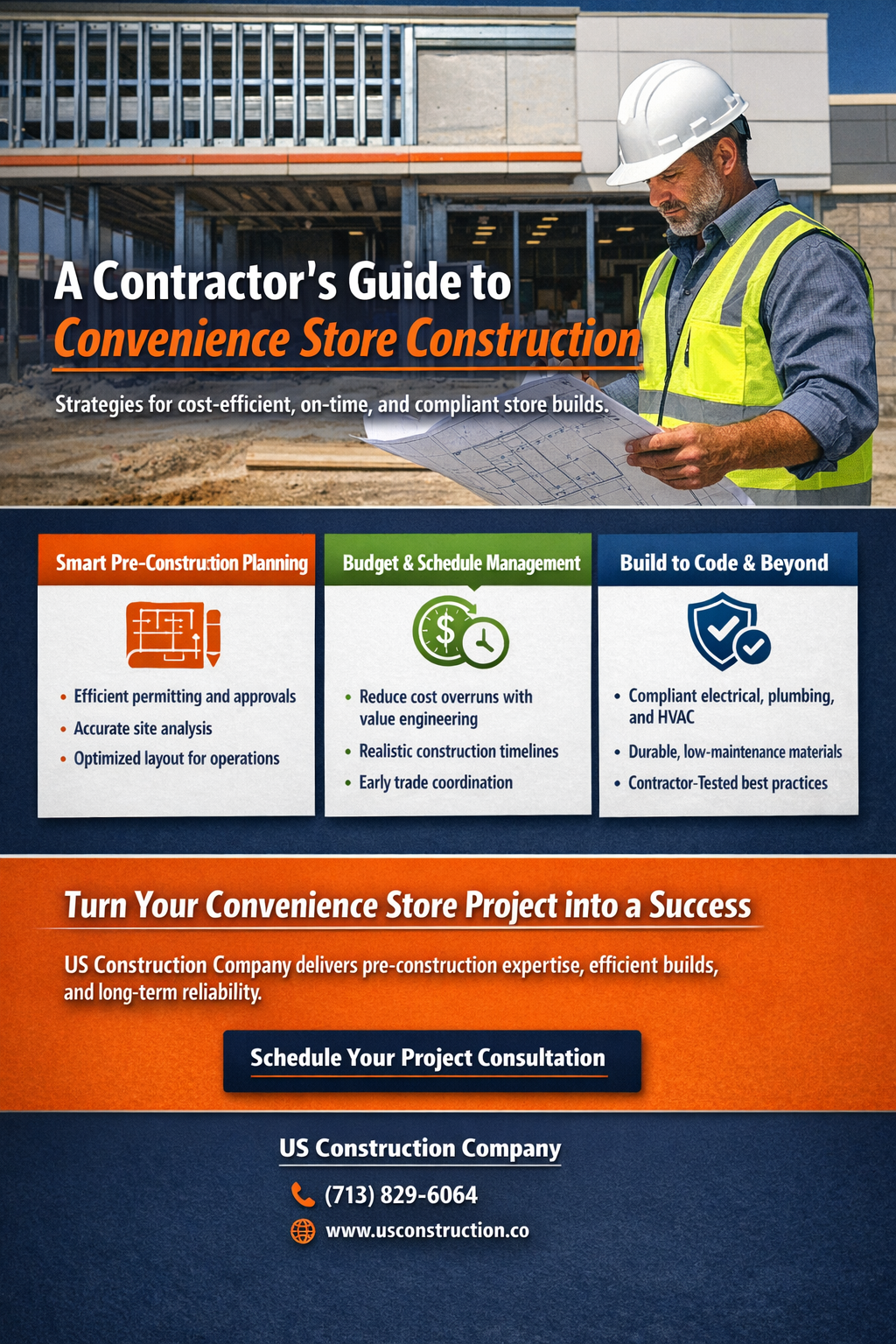
Convenience store construction requires perfect synchronization of the fuel station and the retail facility. Contactors have to manage operations to regulate daily traffic flow while adhering to tight operational timelines. A contractor’s guide to convenience store construction gives you an overview of Houston building codes, safety measures, and fuel system regulations.
US Construction Company is competent to handle the complexities of commercial and mixed-use developments. We provide durable materials and efficient custom designs to support long-term performance. Stay with us to understand the strategies required for a compliant, efficient, and profitable convenience store construction.
Understanding Convenience Store Construction
A convenience store is a unique structure for high-traffic, short-duration customer visits. Houston commercial contractors integrate special designs to smoothly manage the operations of the fuel pump and the shopping space under one roof. These constructions require strict adherence to zoning, safety, and environmental regulations. Common facilities of a convenience store include:
| Retail Space |
|
| Food Service Areas |
|
| Fuel Station |
|
| Other Amenities |
|
Most convenience stores range in size from 2,500 to 6,000 square feet and include a food court. 4 to 12 pumps are positioned based on location, and available land configurations are customized.
Pre-Construction Phases of Convenience Store Construction
Construction of convenience stores is complex and requires professional planning and site analysis. Experienced developers conduct comprehensive feasibility checks and evaluations to ensure the project’s success. Here, we give an overview of pre-construction considerations.
Regulatory and Site Planning Considerations
In Houston, ignorance of city zoning and planning enforcement put more pressure on construction companies. They have to comply with multiple land-use laws for commercial construction. City Planning & Development Department outline strict regulations for parking, landscaping, sidewalks, and access routes.
Site Selection
Local developers must conduct thorough site assessments to ensure the success of convenience stores. The common strategies they follow are:
| Traffic and Accessibility Checks | The proposed site should have ample space, visibility, and proximity to roadways. The suitable site can accommodate customers and manage high vehicular flow. |
| Demographic Analysis | Understanding the nearby community’s needs, the distance from the market, and existing retail offerings. All these factors affect potential sales and demand. |
| Existing Utility Capacity Verification | The present utility connections can support convenience stores, sewer, electrical and natural gas requirements. In fact, the utility supplies upgrade is a very costly and time-consuming process. |
| Environmental Site Assessments | Developers involve environmentalists and geologists to conduct an environmental impact report. These studies evaluate the risk of this construction to natural resources. They need to provide effective mitigation plans to achieve NOC. |
Permitting and Approvals
The Houston convenience store construction companies start the permitting and approval process at the early planning phase to prevent project delays. The permits and reviews at the pre-construction phase are:
- Site Plan Review: Contractors collaborate with Houston’s Planning & Development Department to verify the proposed site design features. They provide a comprehensive layout of structures, parking areas, drainage systems, access roads, and landscaping.
- Building Permits: Houston Permitting Centre is the central authority to approve the architectural, mechanical, electrical, and plumbing systems. The integration of fuel dispensers makes the construction of convenience stores more challenging.
- Environmental Permits: Developers need to follow guidelines for underground storage tank regulations and mitigation measures for spill prevention.
- Specialized Reviews: Authorities consult a Registered Accessibility Specialist (RAS) for convenience store inspection. These personnel verify the site’s accessibility.
The permitting process requires comprehensive documentation and record-keeping to ensure a smooth, hassle-free experience. Weak paperwork and incomplete submissions require repeated revisions and penalties. Early planning and professional collaborations improve the responsiveness of official reviewers.
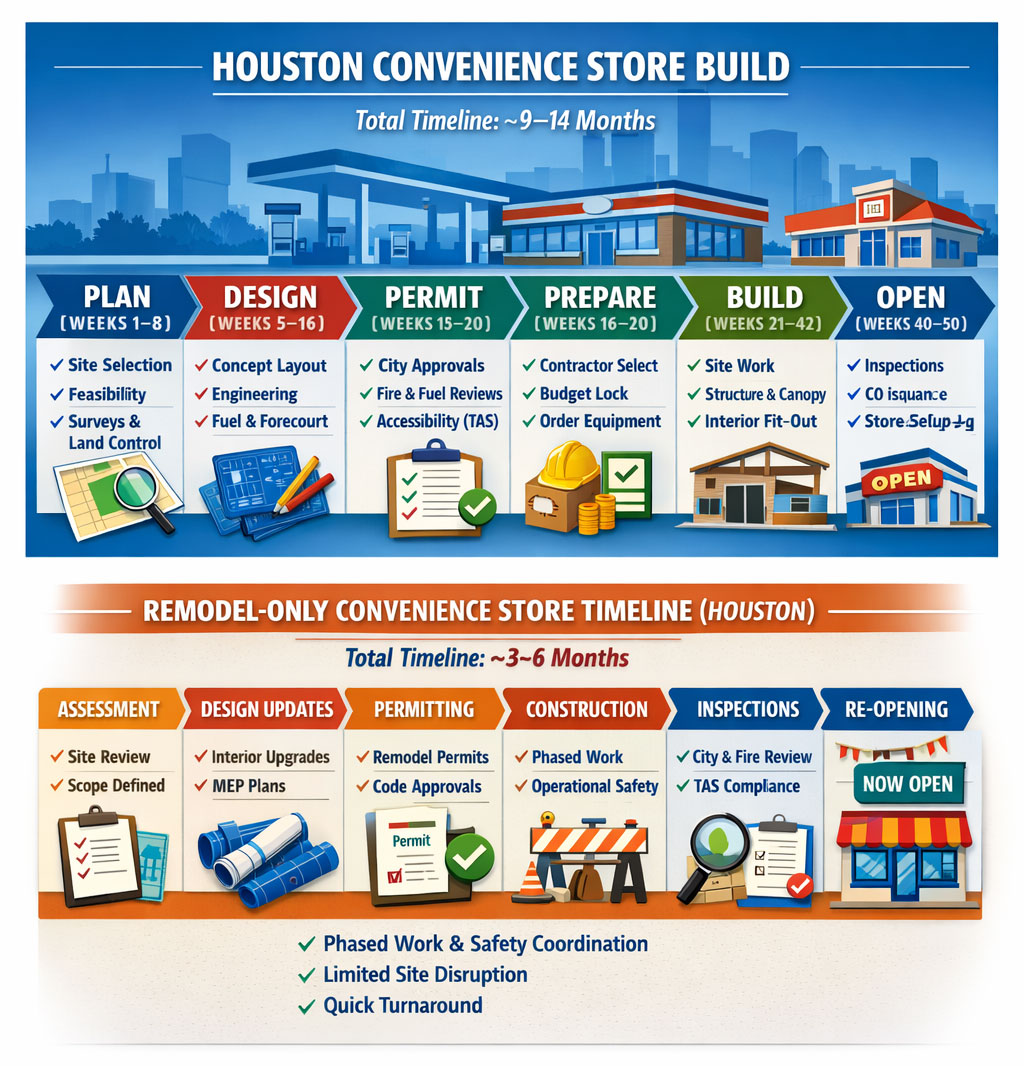
Design and Pre-Construction Development
The design of a convenience store depends on its size and proposed facilities. The experts understand the demands of each configuration and consider the following aspects:
- Retail structural design and MEP systems planning is the first step and requires professional collaboration. Contractors arrange meetings of the in-house team of architects and engineers to develop site structural layouts.
- Branding signals are unique when a special corporation is investing in multiple outlets in different locations. Experts integrate interior finishing, passenger circulation, signage, and exterior facades in a specific format.
- Mechanical, electrical, and plumbing (MEP) supplies should accommodate the required demands of the HVAC system, electricity load, and fire protection systems.
- Fuel canopy design is effective for visibility and traffic control. The underground fuel tank specifications should complement the daily operational criteria.
Long-Lead Procurement Planning
Some materials and supplies have long lead times, so the constructors planned their purchasing decisions based on their work sequencing. The common equipment with long lead times:
- Food refrigeration and storage units,
- Fuel pumps, meter, and underground tanks,
- Systems of point-of-sale (POS and security system installation.
Early procurement is the best way to reduce the chances of delays and other complications.
Budget and Risk Planning
Commercial builders prepare comprehensive cost estimates to meet regulatory requirements. They add the land’s initial cost or its leasing payment to the budget. Moreover, it covers permitting fees, designers’ charges, and construction equipment rental fees. Contingency plans are essential for protecting against unforeseen and severe weather conditions.
Technical Pre-Construction Activities
Mixed-use constructions require customer satisfaction and regulatory compliance. Professionals manage extensive site preparation and planning to deliver safe, long-term value to convenience stores.
Site Preparation
Before starting construction, a geologist analyses the soil chemistry and structural strength of the job site. The position of the water table and the soil’s load-bearing capacity are essential to finalize the pre-treatments of the construction site.
For weak or clay soil, extensive excavation, grading, and stabilization are required for durable development. The capacity and condition of existing utility connections are evaluated to meet high-end use.
Fuel System Planning
For selecting the underground tank layout and spacing based on natural water resources, preliminary studies are essential. The design, pumping capacity, and lighting of the fuel canopy are structured according to daily operational requirements.
Contractor Selection
Always choose experienced Houston commercial or mixed-use contractors with a history of similar projects. Only reliable professionals can handle the design and regulatory complications of convenience store construction. They understand the technical specifications of fuel, refrigeration, and POS integration while adhering to building codes.
Major Construction Stages in Convenience Store Projects
Commercial-scale developments require planned, sequential operations. Delays or errors in the initial phases impact the overall timelines and budget. Experienced general contracting companies deliver consistent quality, safety, and timeline control.
Site Preparation and Earthwork
The durability of final structures depends on effective site operations. The nature and condition of the soil outline site-clearing, demolition, mechanical treatment, and erosion-control practices. Houston’s vulnerability to extensive flooding focuses on the drainage system, compaction, and elevation. Likewise, a comprehensive earthwork reduces the chances of costly repairs.
Foundations and Structural Construction
After site preparation, foundations are built in accordance with engineering guidelines. Slab-on-grade systems, grade beams, and footings are suitable for clay-rich land. For long-lasting durability, steel frameworks are involved. Code-compliant practices directly impact the quality of the construction
Underground Utilities and Fuel Systems
Underground work laid the foundation for effective development. Contractors install sewerage pipelines, electric cabling, and communication lines. The underground fuel storage tanks require special preparations for spill control and piping supplies.
Canopy and Exterior Work
The layout of the convenience store complements the daily operation and traffic flow. External features cover the exterior walls, roofing, windows, and doors of the enclosure. Special branding signals and lighting cover the fueling station and canopy. ADA accessibility is included in exterior finishes.
Interior Build-Out and Equipment Installation
At the final stage, the interior finishing and machinery installation are completed. The POS infrastructure, food area, and fuel station equipment are installed. All mechanical, electrical, plumbing, and refrigeration systems are tested for performance.
Future Trends in Convenience Store Design and Construction
With rapid industrialization and technological revolutions, the needs of convenience store customers have changed. Now the local commercial construction experts focus on advanced amenities like:
| EV Charging Integration |
|
| Expanded Food Service Areas |
|
| Energy-Efficient Building Systems |
|
| Modern Branding and Façade Design |
|
Houston Commercial Contractor Near Me
Successful convenience store construction needs effective planning, budgeting, and professional collaborations. Hiring a reliable commercial contractor in Houston, Texas, reduces the risk of cost overruns, schedule delays, and operational issues.
US Construction Company conducts comprehensive site evaluations to ensure secure utility connections and regulatory compliance. Contact us for operationally efficient and customer-appealing convenience store construction.
FAQs
Q 1. What special permits are required for the construction of convenience stores?
Convenience stores are mixed-use structures with fueling and retail establishments. The developers have to handle multiple permits for site selection, fire marshal compliance, environmental review, drainage regulations and accessibility certification. The Houston Permitting Centre is responsible for approving all permits.
Q 2. Is the construction of the convenience store affected by its site’s soil conditions?
For durable foundation development, the contractors analyze the proposed site soil strength. Weak soil needs some mechanical and chemical stabilization to withstand heavy traffic loads. These additional treatments increase the time and cost of the construction project.
Q 3. How can a convenience store remain operational during renovations?
With the expert supervision of commercial contractors, the convenience stores remain open even during their renovations. They manage their activities using a phased approach to minimize disturbance to visitors and staff. To keep the site clean, they receive shipments of materials when needed, and don’t stock in bulk at the construction site.
Q 4. What strategies are required to ensure the safety of fuel system installation?
Reliable developers plan fuel system designs and installations in close coordination with civil engineers and conduct site environmental assessments to determine suitable underground storage tank configurations.
Leave A Comment