
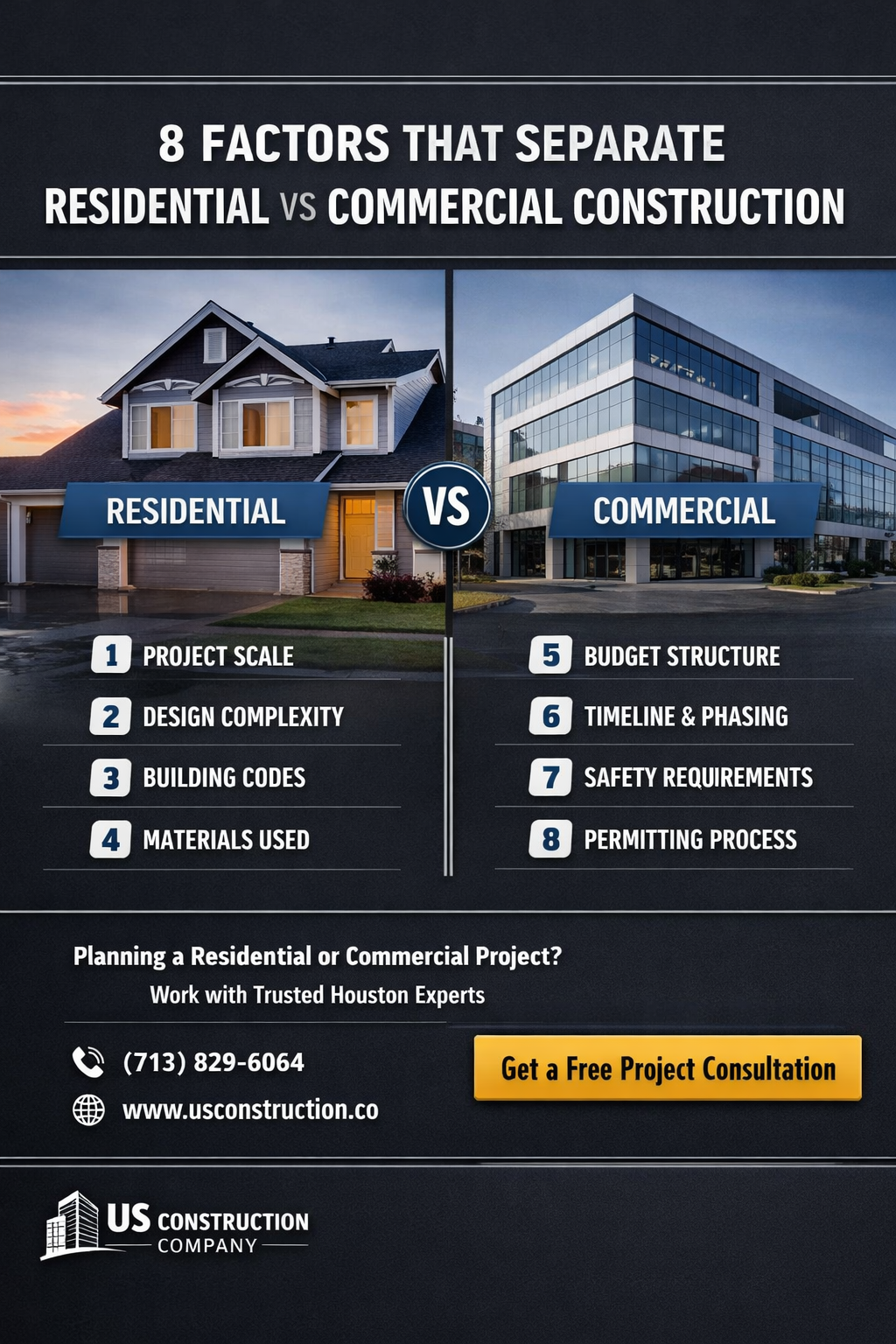
In the construction industry, residential and commercial projects are entirely different. Each has a specific budget range, activity scale, stakeholder involvement, and regulatory framework. Here, we elaborate on 8 factors to distinguish residential from commercial construction for a clearer understanding.
In the United States, residential development accounts for 40% of construction spending. In fact, residential construction is short-term and requires simple permitting and design specifications. Commercial infrastructure is complex, requires substantial capital investment, strict compliance requirements, and specialized materials. US Construction Company effectively manages projects of all sizes and types.
Differences between Residential and Commercial Construction
Residential and commercial construction require specific planning, design features, management, and monitoring tactics. Each project has its own needs, risk factors, and performance indicators. What distinguishes home construction from commercial building can be fully explained by the following elements.
-
Purpose and End Use
The expected use of the construction makes the real difference. The goal of residential construction is to give people and families secure, cozy places to live. Practicality, privacy, beauty, and individual comfort are the main aspects of efficiency.
Commercial construction, on the other hand, prioritizes productivity, flexibility, strength, and regulatory compliance over customization. They support different types of businesses like corporate offices, warehouses, or retail stores.
-
Project Scale and Complexity
Residential projects are mostly small-scale developments, such as low-profile housing, condominiums, or single-family homes. Commonly, they rely on standardized, straightforward layouts and supplies; the frameworks are relatively easy to build.
On the other hand, commercial development comprises much larger dimensions, multiple floors, larger tenant loads, and sophisticated engineering systems. Houston commercial contractors incorporate reinforced materials and specialized installations to ensure durability and compliance with safety standards.
-
Design Requirements and Standards
Residential construction offers greater customization based on consumer preferences. Most homeowners prioritize convenience, simplicity, and aesthetic appeal. In commercial buildings, design features support operational efficiency, safety measures, accessibility, and energy conservation.
Business-related infrastructure must withstand the movement of heavy machinery and increased tenant mobility. Thus, the contractors use special design and construction materials.
-
Regulatory and Code Compliance
The construction industry has a strict legislative framework for home or workspace development. However, building for commercial purposes is subject to more stringent and comprehensive requirements. They need to provide emergency exits, accessibility features, and occupational safety compliance.
Compared to workplaces, home construction typically follows streamlined domestic regulations with less monitoring and regulatory oversight.
-
Materials and Construction Methods
In the home build-outs, most likely the optimal-grade materials and suppliers are used that can withstand daily use. The experts install wooden frames, medium-thickness metallic sheets, and cost-effective finishes. Well, for business-related settlements, heavier, more durable materials are needed.
Houston general contracting companies use reinforced concrete and steel framework in commercial infrastructure. They implement phased scheduling, precast components, and modular construction techniques for maximum strength.
-
Budgeting and Risk Profile
Residential projects typically have simpler schedules, easier financing arrangements, and smaller budgets. The likelihood of risk is minimal, and investment usually involves housing or personal loans.
On the other hand, significant capital is required for commercial development, which is often financed by investors, corporate creditors, or public-private partnerships. Budgeting and risk control are crucial for longer, higher-investment projects. They are more susceptible to market fluctuations.
-
Stakeholders and Decision-Making Process
Homeowners, contractors, and municipal officials are the stakeholders involved in residential building, which facilitates quicker decision-making and more informal interaction. In commercial development, builders, investors, architects, engineers, regulatory bodies, and potential tenants are all directly involved. So, any changes must be thoroughly reviewed and approved, and systematically documented.
-
Maintenance and Performance Expectation
Housing structures were built for consistent maintenance and modest daily occupancy. Business buildings are expected to function effectively for decades and withstand constant, heavy use. In business construction, this raises the bar for material durability and regular maintenance, which has a direct impact on initial and ongoing operating costs.
Which Construction Expert Is Right for You?
Construction is a complex process that involves legal and structural specifications for each activity. Depending on the nature and scale of the project, the property owner should hire the professionals at an early stage. For the safety of employees and construction workers, contractors follow safety measures.
Residential Construction:
If you are a landowner constructing or remodeling an individual residence, condominium, or small household unit, a residential contractor is the best option.
- Giving preference to personal choice, convenience, and design flexibility.
- Adhering to a predetermined budget and a shortened construction schedule
- Looking for a contractor with knowledge of local zoning regulations, residential rules, and materials
The finest projects for building homes are those where the primary motivators are affordability, timeliness of completion, and lifestyle requirements.
Commercial Construction:
In such developments, considerable investment is required, and a partnership among multiple stakeholders is needed.
- Having to adhere to stringent construction requirements, safety laws, ADA guidelines, and environmental codes.
- Trying to develop high-occupancy venues like offices, shopping malls, hospitals, or industrial structures
- Concentrated on long-term investment, operational effectiveness, and longevity.
When efficiency, capacity, legal compliance, and profitability are vital success factors, commercial buildings are crucial.
Stakeholders may be exposed to safety hazards, expensive redesigns, and regulatory infractions when a residential contractor is hired for a commercial project. Remarkably, to meet the specific technical and regulatory requirements of each construction type, knowledge, a license, and project management skills are required.
Find General Contractor Near Me
Before starting construction, understand your needs to plan better, secure permits, budget, and execute. Every type of building has a unique function and requires an appropriate strategy. Hiring a reliable construction company protects from expensive delays or rework.
Contact US Construction Company, a qualified expert familiar with the specific requirements of your project.
FAQs
Q1. Can a residential construction be converted into a commercial setup?
Yes, but the procedure is intricate and highly restricted. You need zoning permission, conversion approvals, and full compliance with commercial construction requirements. It may fulfill fire safety, disability access code (ADA), vehicular parking, and tenancy criteria. These regulations are necessary when converting a residential property into a commercial business.
Q2. Do registered residential contractors manage commercial construction projects?
Yes, in many regions. Contractors working in commercial construction are usually required to possess particular licenses, certificates, and insurance coverage. These qualifications ensure the contractor is capable of overseeing more complex projects and of meeting safety and legal requirements.
Q3. Do insurance coverage differ for residential and commercial constructions?
More extensive assurance is typically needed for commercial construction projects for risk management. It covers contractor’s risk policy, workers’ compensation, and liability protections. However, for home construction, the scale of assurances is smaller.
Q4. Which construction gives you a better return in the future?
Project goals determine ROI. Residential buildings often generate rental income and steady, long-term property appreciation. Commercial construction includes greater investment risk but yields higher ROI through rentals, business activity, or future sale. In both situations, market research and strategic planning are essential.
Leave A Comment