
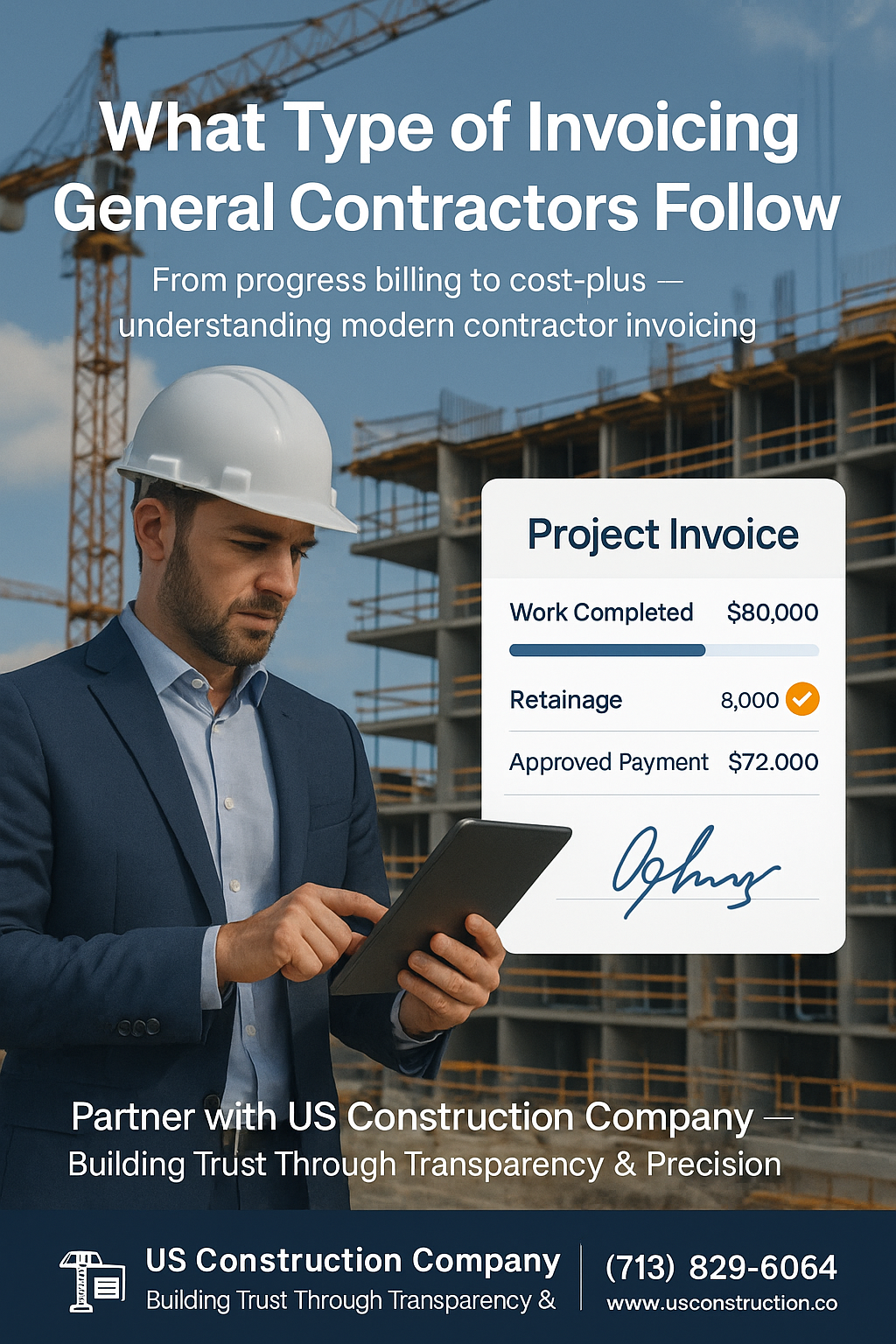
Construction’s documentation procedures and legal conformity always require reliable professional support. General contractors are the authority personnel who handle all paperwork and on-site complications. Proper invoicing and record-keeping are essential for smooth execution. Here, we want to know what type of invoicing general contractors follow.
US Construction Company manages and communicates precise and timely invoices, keeping all parties satisfied and collaborative. Proper management and on-time payments reduce the risk of supplies and labor. In residential projects, milestone-based invoices are feasible, while progress billings reduce inconveniences for commercial construction.
Understanding Construction Invoicing
Construction invoicing differs from the rest of the businesses, involving more stakeholders, complications, and payments based on milestones. It covers a detailed record of raw material purchasing, labor wages, permit fees, and actual work progress. Some more complications that are involved are:
- Progress-Based Payments: Contractors file invoices or bills based on the completion of a specific construction phase.
- Retention/Withholding: The construction company can hold 5 to 10% of the total payment as security to manage payment delays or handle unforeseen expenses.
- Change Orders: Any modification in the design requires adjustment in the invoicing and billing system, including a material rate list and other necessary expenses.
Key Elements of Construction Invoice
The essential parts of residential, commercial, or industrial construction projects are:
| Project Details | Project’s geographical location, serial no of the construction contract, and invoicing date |
| Scope of Work | Brief overview of project details and exact billing period. |
| Labor and Material Costs | Item-wise rate of material with number and per-hour labor cost |
| Retention | Hold the amount as per contract terms. |
| Change Orders | Cost estimation that impacts the overall budget |
| Total Amount Due | Including tax and other adjustments if applied |
Who is Involved in Invoicing
Construction invoices need mutual work and collaboration of different stakeholders, including:
- Project Owners: The investor who checks the details and onsite completed work.
- Project Managers: Handle technical compliance concerns, supervise material specifications.
- Accounts Teams: Research and validate the authenticity of billing calculations and tax compliance.
- Contractors/Subcontractors: Oversee all construction and invoicing processes.
The invoice should be detailed and precise to reduce inconvenience and smooth cash flow throughout the construction.
Common Types of Contractor Invoicing Methods
The nature and type of billing vary with the scope and scale of the construction projects. Moreover, the customer’s preferences and contractual terms and conditions impact the invoicing pattern and protocols. Selecting suitable methods manages timely payments, adequate compensation, and compatibility with overall completions.
-
Lump Sum or Fixed Price Invoicing
The standard method is a pre-fixed and calculated total cost, primarily for small-scale residential construction projects. Under this protocol, the contractor should be clear about the project’s scope to reduce disputes and the need for rework. The Houston general contracting companies have some pre-set cost estimations for a particular type of project.
-
Time and Material (T&M) Invoicing
Payment is based on the total amount of the raw material used and the hourly based wages of deployed labor. When the customer is uncertain, they need a construction company to work on renovating old buildings. So, T&M invoicing is effective for maintenance and repair work. The professional must carefully manage the record involving human power and raw materials.
-
Cost Plus Invoicing
When the contractors require their consultation and execution fee separately. They provide the precise details of used resources in a cost-plus invoice with pre-defined charges. This method will give the construction company a better profit margin and transparent billing. Mostly, the professional opts for it when the project scope cannot be projected in the initial phase.
-
Unit Price Billing
For refined masonry work like foundation preparation, concrete/tilling fixing, or piping installations. The charges are expressed per cubic yard. The area under work is carefully measured, and the cost estimation for supplies and labor should be accurate. Unit price billing is effective for volume-based projects.
-
Progress Completion Billing
Payments are tied to specific stages of construction. These milestones are mutually agreed upon and written in project contracts. Sometimes, the phases of progress are linked with a timeframe every month. This method is suitable for proper cash liquidity and in-depth work monitoring.
Progress Billing: Common Houston General Contractor Method
Progress billing is the professional’s most trusted and convenient method that directly aligns payments with completed work. Its structured approach reduces the chances of miscommunications and develops a harmonized connection between contractor and client. They don’t need to wait for the payment till the end of the project. Likewise, the clients can easily monitor the quality and speed of work.
How Progress Billing Works
- A timeline of outcomes is clearly stated at the beginning of the work, after which the contractor will claim payment.
- Contractors compute the invoice value after analyzing updated records of the finished work, which improves accountability.
- The payment request is provided with supporting evidence for customer legitimacy. The experts attach a material purchasing rate list and quality assurance inspection documents.
Benefits for Contractors and Clients
- Cash Flow Stability: This invoicing minimizes the chances of miscommunication and payment delays; both parties took responsibility for the next action.
- Accountability and Transparency: The cost of each item and labor expenses are written clearly, which makes professionals more credible.
- Risk Reduction: The inconveniences of all parties are detected at the initial stage, which reduces and mitigates risk factors.
Timeline and Documentation
The timeframe of the progress billing is mutually adjusted at the customer’s convenience and that of the competent Houston general contracting firm. However, the standards paperwork involved in this procedure is:
- Detailed work progress reports
- Material purchasing receipts
- Verified order change
- Updated plan for the following process
Software Used in General Contractor Invoicing
The technological revolution of the construction industry also improves its invoicing with digital control and automation. Progress and payment plans are now tracked more precisely and automatically regulated with project management systems. Some commonly used tools are:
- Procore – Innovative program for record keeping of invoices, cost estimations, and RFIs and interlinked with accounting systems.
- Buildertrend – Monitor the execution of work according to schedule and generate billing automatically.
- QuickBooks Construction– Blend of E-invoicing and accountancy tools to perform well.
- Sage 300 Construction – Support improved control over billing records.
Integration with Project Management Systems
These innovative invoicing tools can be integrated with project management systems for better collaboration and tracking. Automatic control keeps them updated with payment patterns and actual field progress. It reduces the chances of human errors and improves customer trust and contractors’ credibility.
- Speed: The project timelines are reduced with better execution and documentation control.
- Transparency: With an online dashboard, each stakeholder knows the latest progress and billing status.
- Record Keeping: Digital tools are proficient in developing bills on pre-decided templates and reducing the process time.
Common Invoicing Challenges in Construction
Even with precise control and tracking systems, some invoicing loopholes in the construction sector are impacting this business. These setbacks halt the capabilities of the contracting firm and result in the loss of possible market share.
-
Payment Delays and Disputes
Sometimes, the customer is unsatisfied with the final results and has not released the expected payment. Such situations can impact the overall success factor of the project and impede cash flow. Only careful record keeping and documentation can overcome these misunderstandings.
-
Incomplete Documentation
If the contractors neglect to document the well or don’t follow the standard format of the invoice, it will be rejected by the customer. Construction bills should be detailed with a precise record of each item. This administrative delay will impact the overall project timeframe.
-
Repeated Scope and Order Changes
In construction, the uncertainty is the triggering factor that cannot be overcome. Sometimes the customer asks for modifications that need a complete alteration in invoicing. If the contractor didn’t pay complete attention, it would lead to financial disputes.
-
Retention Policies Holdbacks
The invoicing and account sections should be clear and well-recorded; professionals often overlook the retention clause. This security bond will halt their ability to receive timely payments essential for project completion.
Best Practices for General Contracting Invoicing
Experienced commercial construction companies follow standard procedures and execute with tight management to deliver up-to-the-mark structures within the allocated budget.
-
Clear Contract Terms for Payment
The written and mutually signed contract is the backbone of any construction activity, whether residential, commercial, or industrial. The contractor and property owner can claim any process or payment mentioned in the legal contract.
-
Standardized Invoice Templates
The experts should follow widely accepted standard invoicing templates to protect themselves from future inconveniences. Keeping the invoicing style the same throughout the project will ensure legitimacy and good record-keeping.
-
Detailed Job Cost Records
Use precise online platforms to manage the comprehensive records of suppliers’ contact details and pricing. This approach will support the contractor in case of any lawsuit.
-
Regular Communication
Manage timely communications and keep all parties on the same page to reduce conflicts. Conduct regular meetings with subcontractors and customers and incorporate their feedback.
Legal and Contractual Considerations of Invoicing
Invoicing in the construction industry has legislative and organizational significance. It should be in accordance with local and state laws and regulations.
Lien Rights and Payment Bonds
If the customer delays payment, the construction company can file a case against them per the mechanic’s lien rights. Moreover, there is a special provision for a payment bond when signing a contract. The customer is legally bound to clear due payments in a payment bond.
Contract Terms and State Regulations
Invoices must comply with all agreement terms, notably progressive charging, compensation, and installment payments. Focus on proper documentation to prevent administrative or financial fines.
Houston General Contractor Near Me
Invoicing in the construction sector is entirely different; it is not just a receipt to claim payment. A professional Houston general contractor offers a detailed billing method that impacts the overall success of the project. US Construction Company follows standard billing protocols within the legal framework.
FAQs
Q 1. How is the billing process in the construction business different?
In construction projects, the invoicing should be detailed and precise to create a friendly, trust-building relationship with the customer. Reliable developers include used materials, labor, and other resources to prevent future inconveniences.
Q 2. What are the most common methods of invoicing that Houston contracting companies follow?
- Fixed per unit area price
- Time and material billing
- Cost plus invoice
- Progressive billing
Q 3. How can the delays in payments be managed?
The contractors should sign the payment bond when they sign the construction contract with the client. The payment bond obliges the property owner to pay the general contracting firm within the agreed-upon time.
Leave A Comment