
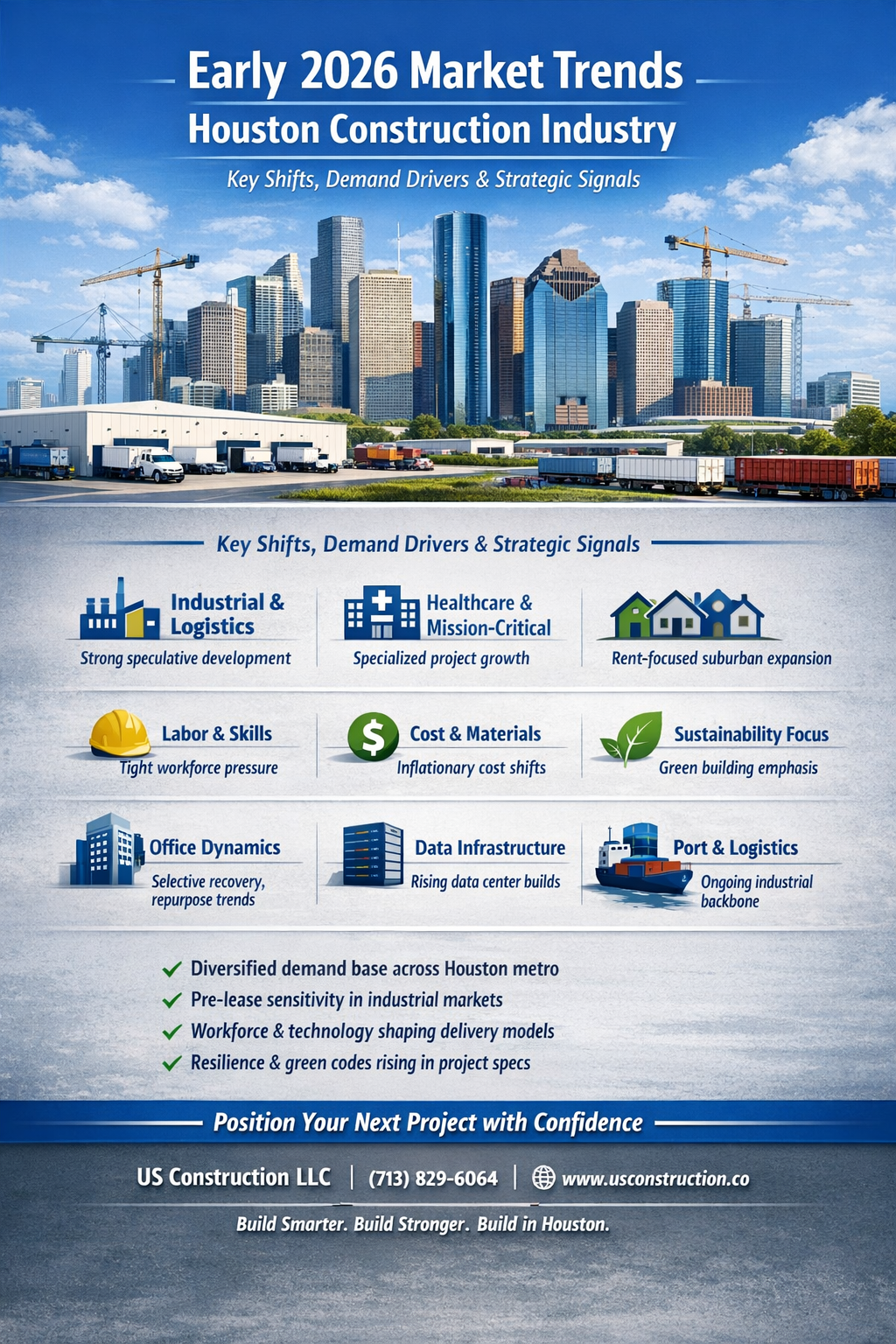
Rapid population growth and diversified economic activities are transforming the early 2026 market trends in the Houston construction industry. Residential development permitting for single-family and multifamily projects in Houston ranks second, after Dallas-Fort Worth. Industrial and logistics construction exceeding 20 million sq ft annually to support e-commerce and energy-sector capex.
US Construction LLC, an experienced general contracting company in Houston, Texas, delivers projects quickly even under continuous pressure. It is expected that construction activities will maintain regular momentum in late 2026, driven by high demand and capital inflows.
Macroeconomic Drivers Shaping Houston Construction
Houston’s construction industry is influenced by underlying macroeconomic factors that drive demand for materials and labor along the supply chain. Here, we discuss the crucial factors driving the residential, industrial, and commercial sectors.
Population Growth and Migration Patterns
A record shift in domestic and international migration is increasing Houston’s urban population. Affordable land prices, employment opportunities, and a growing business climate in Houston attract more people. Continued inbound migration is boosting demand for housing and commercial development.
- Houston is the second-fastest-growing metro added ~198,000 residents in 2024.
- ~75% of the region’s population increase with inbound migration.
- The current estimated Houston population is 7.8 million people.
Housing Demand Pressure
With a high population and shifting migration patterns, demand for single-family and workforce housing units is increasing. The suburban corridors of Katy, Conroe, and Cypress are experiencing high demand for lots, which is driving up property prices.
- Greater Houston approved 65,747 new residential construction permits in 2024.
- Houston is the major construction contributor in the U.S. for permits per 1,000 existing housing units.
Workforce Availability Issues
High levels of development expand the local labor pool. However, there is still a skilled labor shortage in Houston. General and residential construction companies in Houston, Texas, experience project delays due to the unavailability of carpenters, electricians, and plumbers. Moreover, labor wage inflation and material price hikes are frequent.
Energy Sector Influence
The transition from traditional energy capex to modernized facilities underscores Houston’s status as an industrial construction hub. The complex, large-scale development of LNG export terminals and renewable integration grids puts pressure on heavy construction services.
- Houston generating 40% of Texas’s economic output, from oil and gas, and 42% with petrochemical sector.
- $25 billion capital investment is recorded in 2023 on energy-related construction activity.
Oil and Gas Sector Investments
The energy sector is the backbone of Houston’s economic dynamics. Local municipalities are heavily investing in the oil and gas industry, which triggers industrial and heavy civil construction. Developers are focusing on expanding refineries, processing units, and midstream logistics services.
Energy Transition Projects (LNG, Renewables)
Experts are finding renewable resources to meet the emerging demands of the population without impacting natural resources. The enhancements of liquefied natural gas (LNG) facilities, hydrogen power plants, and utility-scale amendments are putting pressure on the construction sector. These projects require diversified capital investment to support the build-out of supportive infrastructure.
Interest Rates and Financing Conditions
The construction industry and investors are supported in completing their projects with financial assistance. Although interest rates are increasing, developers still find it convenient, as the criteria are becoming standardized and simple.
- 4.2 % of increase in construction employees’ wages is recorded in recent economic indicators that keep the industry momentum.
- Current commercial lending rates are increasing, with easy mortgage rates.
Multifamily and Commercial Development
High interest rates directly affect financing for multifamily and commercial projects. Construction companies are prioritizing projects with secure pre-leasing, high-revenue-generating projects, and institutional partnership plans to manage risk.
Private Equity and Institutional Investment Activity
To overcome high premium rates, public and institutional investors are stepping in to provide financing to keep Houston’s construction industry growing. Investors target the logistics sector, residential housing schemes, and industrial growth with simple installment plans. This trend improves liquidity and stability in the construction industry.
Residential Construction Trends in Early 2026
Houston’s residential sector is continuously growing to accommodate rapid urban sprawl. However, it achieved a static expansion trend with disciplined, targeted demand.
Single-Family Housing Expansion
In urban zones, the single-unit construction trend is high. Some highly influential Houston corridors are:
- Katy (West Houston) – master-planned settlement with strong customer demand and the latest amenities.
- Cypress – it experiences consistent lot purchasing and retail expansion.
- Conroe – northward migration creates land availability and pricing concerns.
These areas are relatively affordable to purchase land and are close to employment zones. Rapid residential construction creates pressure on the permitting process. Contractors are now focused on the phased construction method and bulk purchasing to neutralize this drift.
Developed lot inventory is gaining more attention as it reduces land preparation time. Local utility providers facilitate contractors’ fast connections and drainage infrastructure.
Multifamily Market Adjustments
After several years of aggressive increase, multifamily structures are now entering a recalibration phase. Indeed, the absorption rate is slower than in the last few years.
- Urban residential projects face greater competitive pressure than suburban workforce housing.
- The renting trend was high in 2021–2023, now it’s normalized. This led to suitable rental rates.
- Tenant focuses on oversupplied submarkets and greener construction styles.
- The utility supplies connections were high in 2024–2025, and expected to maintain a smooth flow in 2026.
A large pipeline of multistory residential construction projects provides equity positions for each unit. Investors avail themselves of pre-leasing benchmarks and institutional joint ventures.
Commercial and Industrial Development Trends
Houston’s commercial construction sector is improving to upgrade office workspaces, customer comfort, and strong structural shifts.
Industrial and Logistics Boom
Port-related expansion is Houston’s strongest-performing asset. Activities at the Port of Houston trigger the growth of warehouse, distribution, and container-handling infrastructure. Record growth in cargo services and petrochemical exports is observed. Baytown, La Porte, and Pasadena are the strong influence corridors.
Houston commercial contractors experience high demand for temperature-controlled storage and bulk distribution centers. Last-mile logistics facilities development is high but increasingly tenant-driven. E-commerce expansion emphasizes high-clearance facilities, parking lots, and transit access to major highways.
Office Market Repositioning
Adaptive reuse strategies increase the land utilization of office constructions in 2026. Houston commercial contracting companies deliver successful mixed-use buildings. Advanced healthcare facilities with improved service area and equipment remain in a stable demand in Texas.
Tenant custom build-outs are increasingly popular to meet the specific needs of each business. Amenity-driven upgrades with customized office interiors streamline operational activities.
Retail and Mixed-Use Development
Retail construction with mixed-use design accommodates a larger population in a given area. For branding purposes, developers use digital displays, gathering spaces, and integrated dining concepts.
Master-planned communities integrate retail pads, multifamily units, and service amenities. This adaptive approach enhances land value and absorption.
Infrastructure and Public Sector Investment
Public infrastructure is the backbone of improving a region’s economic conditions. Houston’s authorities focus on the expansion and maintenance of roadways, highways, and airports.
Transportation and Highway Expansion
The Texas Department of Transportation (TxDOT) permitted countless projects to advance major corridors. Highway expansion enhances transportation services and helps control congestion.
Flood Mitigation Projects
Weather- and water-resistant structures remain a top priority in the Greater Houston area. Contractors upgrade the existing stormwater management and drainage systems to ensure smooth rainwater management.
High-capacity retention ponds are constructed that align with advanced hydrology modeling. Flood mapping is used at the design stage to inform the installation of suitable foundations and drainage systems.
Emerging Construction Opportunities in 2026
Houston’s diversified economy is creating more investment opportunities in construction. In 2026, the growth of traditional residential and industrial structures is transforming into high-barrier-to-entry asset classes.
Data Centers and Mission-Critical Facilities
The trend toward workspaces and e-commerce businesses is driving the growth of fiber infrastructure. Moreover, the hyperscale and edge data centers are supported with AI-driven upgrades, fintech infrastructure, cloud technology, industrial automation, and IoT growth. They need:
- Power feeds and substations
- Advanced HVAC systems
- Tier III or Tier IV compatibility
- Enhanced security and surveillance
Developers targeting this sector collaborates with utility service providers for power cabling.
Healthcare Facility Expansion
The Texas Medical Center is the largest medical complex in the world, featuring the latest amenities. The leading facilities include:
- Automatic surgery centers
- Specialty clinics with diagnostic services
- Behavioral health center
- Ambulatory services in suburban markets
Suburban population growth increases the number of suitable healthcare facilities, prompting providers to decentralize from core campuses.
Advanced Manufacturing Unit Projects
Federal incentives are mitigating supply chain risks by expanding high-output manufacturing facilities. The major investments are in:
- Petrochemical refineries
- Energy transition equipment
- Industrial machinery fabrication
These projects require extensive earthwork and site preparation to withstand heavy-duty operations and building loads.
Houston Commercial Contractor Near Me
Align your investment strategy with current construction trends to achieve maximum returns and legal compliance. US Construction LLC is a reliable construction partner that understands the Houston market trends, smart construction methodologies, and sector-specific build requirements.
Contact us to schedule a project feasibility consultation and have dedicated experts working for your business’s success.
FAQs
Q1. Is Houston’s construction industry projected to grow in 2026?
Yes, it will expect continuous growth in construction, but some sectors are leading the way. It includes manufacturing units, healthcare, infrastructure, and suburban residential projects. In fact, the growth is a disciplined expansion with specific goals and objectives.
Q 2. Which Houston construction sector will offer the best ROI in 2026?
In Houston, the port is a major contributor to the local economy. So, investing in construction projects of industrial and logistics facilities offers a better return. Similarly, residential developments in suburban corridors will boost property values in the coming years.
Q 3. Do high interest rates impact construction activities in Houston?
Higher interest rates reduced speculative starts in the residential and commercial sectors. However, some private investors and institutional partnership plans offer simple leasing and financing options. Developers are focusing on value engineering and smart construction technologies to control cost and deliver durable buildings.
Q 4. What are the biggest risks in the construction business?
In the construction business, risk factors are:
- Labor and material shortages
- Permitting delays
- Drainage compliance requirements
- Local market volatility
Developers conduct extensive feasibility checks and planning for mitigating these risk factors.
Leave A Comment