
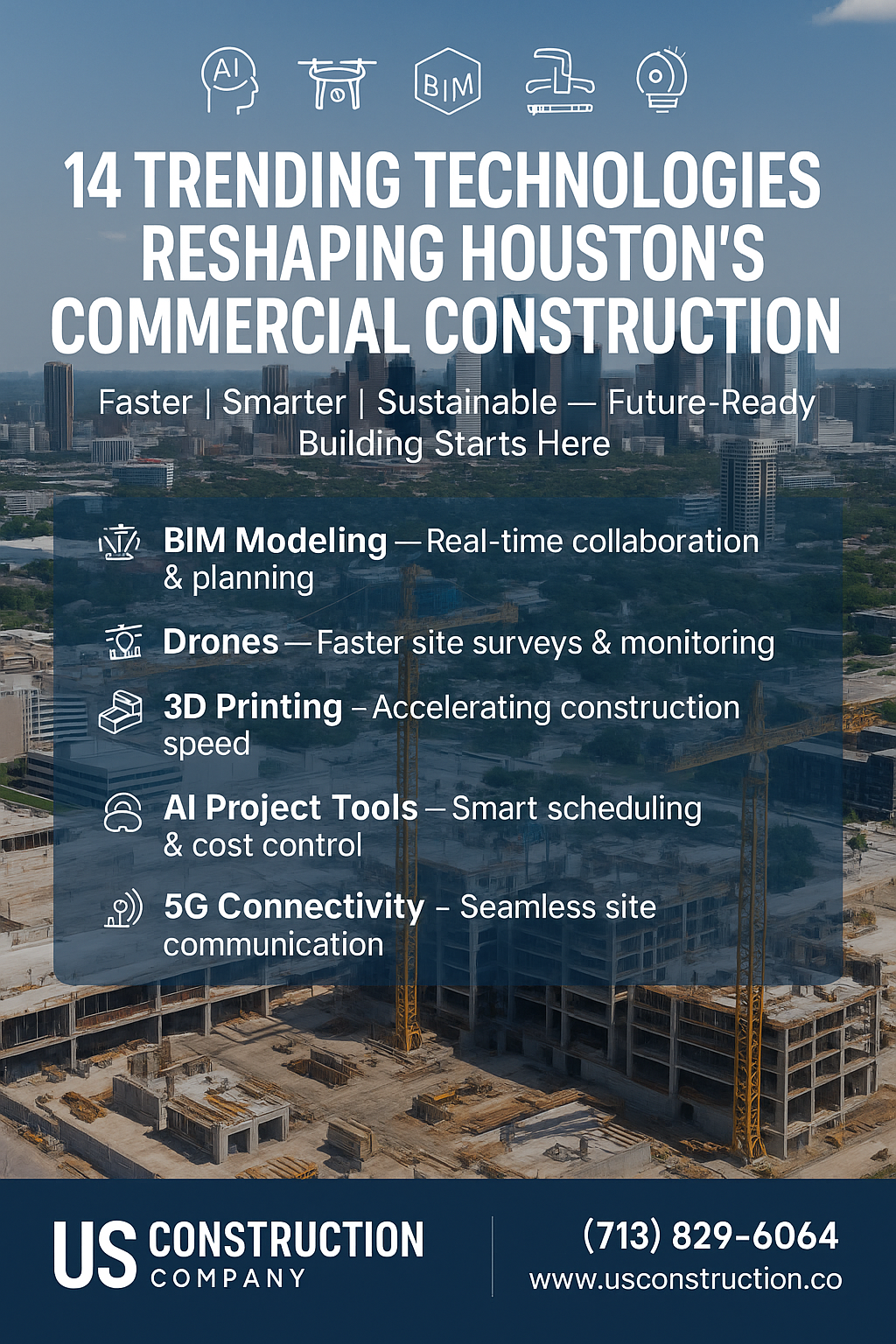
Houston has experienced a transformation in commercial construction patterns over the last few years. This trend accommodates the rapid population increase, innovations in the energy sector, and a surge in the demand for greener buildings. Here, we discuss 14 top trending Houston commercial construction technologies, fueling tech-driven business to logistics centers.
US Construction Company is playing its part by integrating smart technologies into its construction strategies. We implement digital management tools and smart sensors to reduce project timelines and optimize resource use. This shift boosts the concept of sustainability, customer-focused, and long-term operational savings.
Why Technology is Transforming Commercial Construction
Construction is the most vulnerable sector. Its profit margin ratios are too low and are badly impacted by changes in the raw materials and labor supply chain. Now, professionals are trying to overcome such inconveniences with innovative technologies.
-
Tackling Specific Challenges
The technological revolutions have specific solutions for residential, commercial, and industrial issues. The nature and scale of the projects define the selection of assistance to handle the problems at the ground level.
-
Innovation as the Solution
Modern construction technologies have completely changed the planning and execution to deliver targeted results. Different software and aerial technologies handle project management and supervision concerns. Some modular or prefabricated structures reduce construction timelines.
-
Competitive Edge in Market
The constructors using such innovations in their action plan will have more customer trust and better market reputations. They can provide:
- Deliver projects faster
- Higher safety standards compliance
- Offer cost-effective solutions
A Houston commercial construction company with advanced technologies can handle risk factors better and maximize ROI.
14 Trending Technologies Shaping the Commercial Construction
Business trends and activities are changing, requiring suitable workspaces to accommodate emerging demands. Here, we explain the most commonly adopted technologies in commercial project development.
-
Building Information Modeling (BIM)
BIM is the digital platform for managing construction projects. It is the most in-demand tool professionals trust for timely completions within allocated resources. By providing updated data to all stakeholders, BIM facilitates smooth collaboration.
- Benefits:
BIM significantly lowers shortcomings during the planning phase by identifying conflicts across systems. It reduces the need for expensive rework. It guarantees better budgeting, manages schedules, and fosters better cooperation between all partners.
- Applications:
Effectively used in mixed-use projects throughout Greater Houston, high-rise office complexes, medical institutions, and infrastructural improvements.
-
Drones and Aerial Mapping
For a hard-to-reach construction site, the area mapping is the optimal choice. These drones are integrated with LiDAR detectors for reliable feasibility studies. They may record site physical characteristics, operational information, and safety insights in seconds.
- Benefits:
Drones do surveys more accurately in hours than traditional methods, which might take days or weeks. The planning process is accelerated, management has better site vision, and worker safety is improved.
- Applications:
Uses include massive shopping centers, highway extensions, factories, and the construction of logistics hubs in the Houston area.
-
3D Printing and Prefabrication
Prefabrication is the production of construction parts off-site to speed up the process. However, 3D printing uses innovative supplies to construct structures step by step.
- Benefits:
Before constructing the physical structure, the contractors check the operational testing of its 3D models. This strategy reduces the need for rework and waste generations.
- Application:
It is utilized in low-rise commercial buildings, retail establishments, colleges, movable offices, and complex housing developments.
-
AI-Powered Project Management Tools
AI-powered applications use machine learning to monitor real-time labor consumption, finances, timelines, and hazards.
- Benefits:
Machine learning and AI-driven data analysis reduces occupational hazards and costly downtime. This increases profitability and significantly decreases delay rates.
- Application:
It is employed in mid- to major business renovations, such as high-end mixed-purpose buildings, hospitals, and public facilities.
-
Digital Twin Technology
A flexible, live-time virtual representation of an actual property or building site is called a “digital twin.” As the structure is planned, built, and run, it changes.
- Benefits:
This enables developers to measure real-time outputs to maximize construction usability. The data is collected to withstand severe weather conditions and make future decisions.
- Applications:
Used in power generation plants, smart office towers, medical facilities, and manufacturing sites.
-
IoT-Enabled Smart Sensors
When the need to track live operational efficiency and surrounding factors like moisture, temperature, and radiation arises, Internet of Things (IoT) sensors are used.
- Benefits:
These devices save unscheduled downtime, enhance the servicing plan, and increase operational safety. They also assist workers in meeting green and safety requirements.
- Application:
The innovative system with improved connectivity is needed in high-end database centers, mineral extraction sites, and sensitive construction zones.
-
Augmented Reality (AR) & Virtual Reality (VR)
AR superimposes electronic information onto the real world, giving a real-life impact to the users. The Houston commercial developers use to check the design permissions before development starts.
- Benefits:
AR/VR reduces uncertainty, increases design precision, and facilitates better client communication. It can detect issues at an early level and be used to train workers.
- Applications:
Check designs for interiors, residential and commercial building layout, and preliminary project presentations.
-
Robotics and Autonomous Equipment
Robotic and automatic machines are used for repeated operations for a long time. It includes Bricklaying, massive concrete pouring, and site clearing.
- Benefits:
When workers are scarce, automation boosts site productivity and lowers accidents. It expedites project schedules and guarantees constant quality.
- Applications:
Used in manufacturing facilities, shipping hubs, major construction sites, and commercial buildings with significant traffic.
-
Modular Construction Systems
In a modular approach, complete building sections are constructed in controlled settings off-site and then put together on location like building bricks.
- Benefits:
It guarantees improved quality control, reduces waste, expedites building timelines, and permits work to proceed despite inclement weather.
- Applications:
Uses include workplaces, lodging, medical, educational, and retail establishments in the expanding Houston suburbs.
-
Advanced Construction Materials
The trend to meet the sustainability goal led towards greener construction suppliers that induce less pollution and ecological footprint.
- Benefits:
They lower future repairs, improve sustainability, and lengthen buildings’ lifespans. These resources are increasingly essential to handling Houston’s harsh climate.
- Applications:
It applies to LEED-certified developments, municipal structures, and green retail spaces.
-
Construction Wearables
On-site workers’ protection and interaction are enhanced by wearable technology such as GPS-enabled safety jackets, smart protective gear, and fingerprinting scanners.
- Benefits:
Wearables lower the chance of mishaps, detect worker position, assess weariness, and deliver immediate safety alerts. They also speed up event reaction times.
- Application:
Helpful for busy industrial operations and tall building construction.
-
Blockchain for Construction Contracts
Blockchain technology generates clear and safe online documents about material purchase, payment milestones, and a digital contract copy.
- Benefits:
Payment issues or delays are eliminated, fraud is decreased, consumer confidence is increased, and legal tracking is made easier.
- Application:
Infrastructural projects, public-private collaborations, and extensive business growth.
-
5G Connectivity & Smart Infrastructure
5G is a novel communication system that offers high device connection, a short delay, and high-speed data throughput. It facilitates the smooth connectivity of on-site detectors and the commanding cell.
- Benefits:
Teamwork and productivity are increased when machines, staff, and management collaborate. This effectively connects IoT, cloud-based data, and area tracking devices.
- Applications:
Large enterprises, smart city initiatives, transit hubs, distribution centers, and intricate infrastructure construction.
-
Generative Design Tools
The generative design analyzes several patterns automatically with an AI assistant. It can check predetermined criteria like expenditure, energy efficiency, material consumption, or mechanical load factors.
- Benefits:
This method minimizes waste, maximizes productivity, and speeds up the design phase. It reduces architectural risk and cost hikes.
- Applications:
In Houston, the urban sprawl needs mixed-use buildings to accommodate more individuals. Houston corporate contractors are experts in developing towering structures.
Houston Commercial Construction Technological Impact
Innovations in construction styles enhance the practical approach with minimal environmental impacts. Here, we explain the need for upgrading technologies in commercial sector developments.
Adapting to Unique Climate
The climatic conditions of any region are the triggering factor that impacts its building output. Also, the selection of construction material depends on local weather patterns.
Comply with Strict Regulations
Furthermore, developers must embrace viable alternatives like green construction supplies and smart buildings due to stricter environmental restrictions. They need innovative technologies for stormwater management guidelines and renewable energy codes.
Real-World Implementation
- Greater Houston’s healthcare and distribution centers are seeing faster development schedules with modular construction.
- With BIM and aerial monitoring, Woodlands and Sugar Land projects are planned reliably.
- 5G networking and live tracking improve coordination for various projects.
- IoT and smart sensors reduce the utility bills of towing workspaces in Downtown Houston.
These technologies offer solutions to Houston’s specific concerns, allowing for faster, more intelligent, and more profitable development.
How Contractors and Developers Can Leverage These Tools
The construction industry is expected to experience more transformations to reduce operational expenses and the impact on the surroundings.
Step 1: Integrate Strategically
Begin by determining high-impact domains where technology could mitigate problems, like smart personal protective wearables for safety compliance, drones for fast site assessments, or BIM for suitable design selection. Teams can increase capabilities without interfering with workflows.
Step 2: Invest in Partnerships
Skilled personnel can better use technology. To optimize ROI, top commercial construction companies should train their employees to maximize the use of technologies. They should also collaborate with research and development departments to better understand the situation.
Step 3: Calculate Operational Benefits
Indeed, the innovative technologies come up with a high initial cost, but the long-lasting impacts mitigate this hike. Some cost-saving results are:
- Less waste generation and need for rework.
- Quicker project completion
- Increased worker safety
- Better project management and legality
- Improved profit margins and reduced long-term expenses.
Step 4: Strengthen Market Position
The early supporters of innovative technology obtain market advantages in bids and win more clients. They can showcase their success, reliability, and safety factors.
In Houston’s changing construction dynamics, contractors who successfully incorporate the latest trends will be considered the best option for high-value business construction projects.
Houston Commercial Contractor Near Me
The construction business is experiencing major transformations to improve profit margin ratios and address job site safety concerns. Houston commercial construction companies that follow innovative trends will have more opportunities to grow.
US Construction Company integrates smart technologies in its planning and operational strategies. Contact us to have next-generation design factors and future corporate-oriented structures.
FAQs
Q 1. Can the latest technologies improve contractors’ coordination and work efficiency?
The digital control of project management and a cloud-based system for data transformation improve work efficiency and reduce human errors.
Q 2. Is adopting commercial construction technology helpful for small construction companies?
Yes. They can get better options to expand their business and have more chances to get high-value projects. However, they have to pay high initial costs, which will reduce the chances of costly errors, speed up project completion, and reduce budget turnover.
Q 3. How does technology contribute to greener construction objectives?
Better utilization of materials reduces waste generation and air emissions. Moreover, resources are used wisely to improve energy efficiency. Building information modeling checks the impacts of construction digitally before construction starts. Such early detections reduce the burden on local resources and meet sustainability targets.
Leave A Comment