
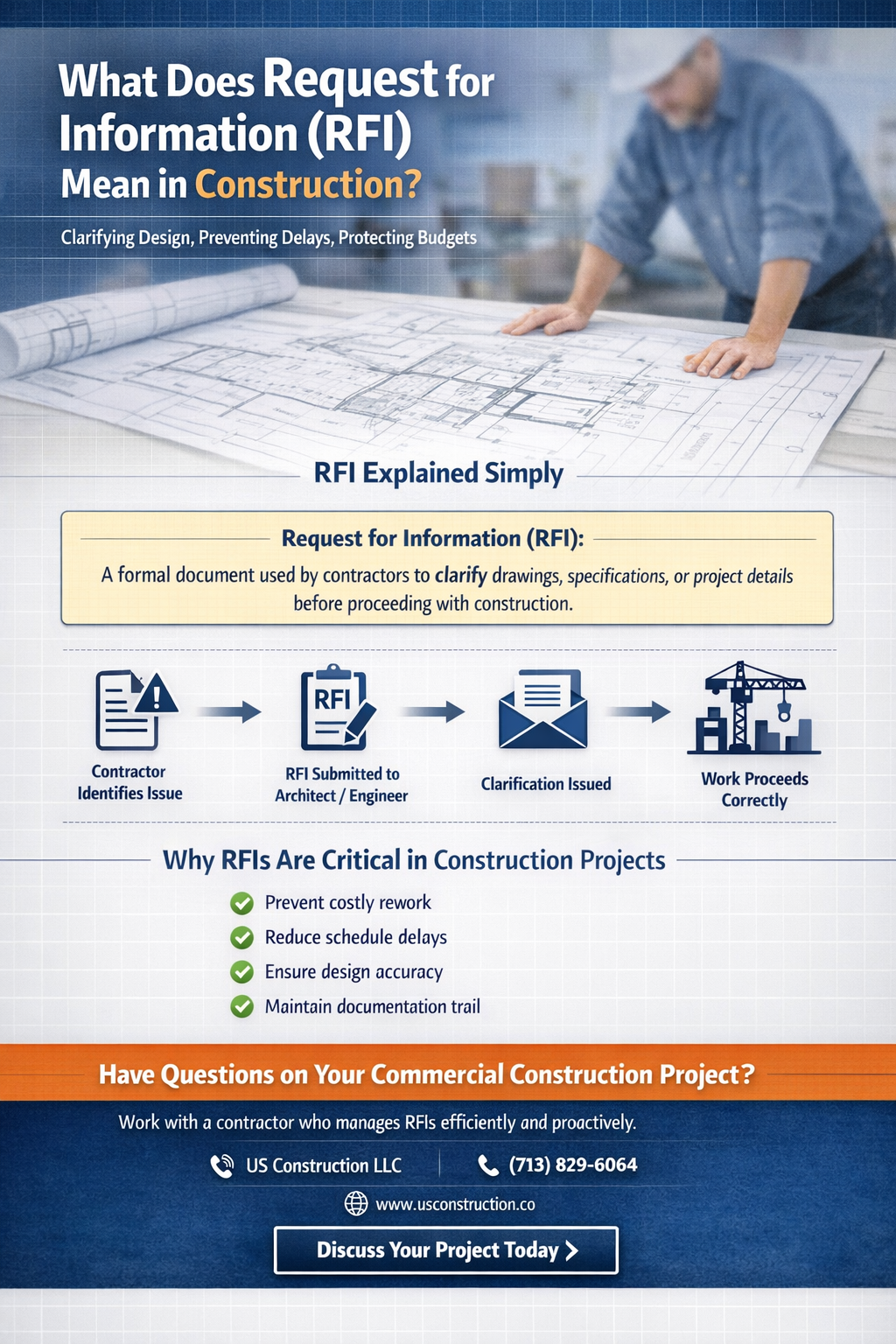
The construction process is complicated, involves multiple stakeholders, and requires detailed documentation. When any of the involved parties find something unclear about the plan, design, or material specifications, they can request RFI (Request for Information). For a more in-depth understanding, join us to learn what does a Request for Information (RFI) mean in construction.
US Construction LLC professionals understand the legal and paperwork requirements for all types of development. They manage effective collaboration among the landowner, general contractor, subcontractor, architect, engineer, and supplier. RFI is a structured communication channel that serves as a bridge to fill gaps and keep the projects on track.
What Is a Request for Information (RFI)?
In technical terms, it is a formal document used to request additional details about construction projects. It may cover uncertain features in design, planning, material selection, and operational process. Unlike informal emails or phone calls, it is a well-documented communication procedure that must be completed before construction starts.
In simple terms, it is a project clarification document to resolve any unclear statements regarding the project’s drawing, planning, and execution processes. Proper management of RFIs reduces risk factors, delays, and costly rework.
Why RFIs Are Essential in Construction Projects
In the modern construction industry, there is no room for compromise on quality or schedule delays. The Request for Information provides all team members with the opportunity to address their myths or misconceptions before work begins.
- Preventing costly mistakes and rework: RFI is the mitigatory measure to clear uncertain terms and conditions in the construction contract. The issues are resolved early, avoiding expensive corrections.
- Maintaining an accurate project schedule: When the unexpected issues are sorted out in the initial phase, there is no chance of project delays and budget overruns.
- Improving communication transparency: Each stakeholder has an equal opportunity to submit RFI, a documented trail of inquiries and responses.
- Supporting quality control and compliance: Accurate explanation of design and quality requirements meets construction quality and regulatory standards.
- Documenting decisions for legal protection: RFIs are the formal records about each aspect of the project. It can serve as a reference document in the event of future disputes or customer claims.
A Request for Information is an effective way to improve teamwork, collaboration, and the smooth completion of projects. Risks are managed promptly without turning into costly mistakes through predictable project execution.
When Should an RFI Be Submitted?
An experienced Houston general contractor fully understands the need and conditions for submitting an RFI. In fact, it is a formal-written request to clear uncertainty or missing information from site planning to the final handover process.
Here, we outline common situations in which a Request for Information is essential for project quality control and resource management.
- Conflicting specifications in drawings: When the design features in the drawing contradict real-world conditions. The contractor or builder submits an RFI to the designer or the architectural team.
- Missing measurements or details: When design dimensions, material quantities, or critical details are lacking in documentation, RFI is crucial.
- Material or product clarification: When the contractor or planning team does not specify the material or appliance type, quality grade, or installation methods. Execution professionals or the landowner can record RFI against them.
- Design intent uncertainty: If the specifications of the layout do not complement the customers’ expectations, RFI is necessary.
- Site condition discrepancies: Construction documents should not be submitted on assumptions. They should meet real-world challenges. RFI supports the team to understand differences from plans or assumptions.
- Constructability concerns: Sometimes, the plans are impossible to implement safely and require reconsideration.
Submitting RFIs is the professional way for all stakeholders to clear their concerns and manage effective collaboration. It is a fair and formal way to obtain accurate information, with a detailed explanation if needed.
What are the Key Components of a Construction RFI
A Request for Information (RFI) is a format document that must follow a specific format. Here, we explain the essential components needed to complete the submission and final approval process.
Project Information and Reference Number
This section covers the fundamental details of the project to ensure accurate traceability and document control. It includes:
- Complete name and tracking number of the project
- Sequential RFI number
- Date of issuing RFI
- Name of contractor company
- Contact number of architect or design team
Accurate details are important for recording the reference ID used in subsequent audits and claims procedures.
Description of the Issue or Question
This section is the core part of the Request for Information. The communication body should include the complete reference materials for the proposed factor for which the RFI is being initiated. Clearly state the conflict, ambiguity, or missing information that requires further explanation. The tone should be formal and fact-based; avoid emotional assumptions.
Supporting Documentation
The recipient must attach visual or technical evidence to establish credibility. Typically, it covers:
- Mock-up drawings
- Actual site photographs
- Specification excerpts
- Materials quality and itemized details
Proper attachments strengthen your RFI submission and timely processing.
Proposed Solution (If Applicable)
In many cases, contractors have a solution or an alternative plan to address RFI. There is an option to state your proposed recommendations clearly. This fact serves as a proactive project management tactic, speeding up decision-making.
Required Response Date
The stakeholder needs to ask for the exact response date to create urgency and protect schedule integrity. It should be:
- Reasonably defined deadline
- Complement with the project schedule
- Outline the authority that is responsible for the delay
This information can be used in project delay analysis and claims evaluation in further documents.
Official Response and Approval Section
This section is completed by the Architect/Engineer of the team. They are authorized to accept or reject the RFI in accordance with the proposed guidelines.
- Record formal response as Approved / Approved as Noted / Rejected status
- Mention date and signature request
- Asked the concerned personnel for revision
They assigned an RFI log to track future communications. The construction documentation workflow needs timely communications to keep the project within the proposed timeframe.
Who is Responsible for RFIs? Roles and Responsibilities
As it is a format document, the roles and responsibilities are well-defined to reduce delay and contractual disputes.
| Submission Responsibility | Contractors and Subcontractors |
|
| Response Authority | Architects and Engineers |
|
| Tracking and Coordination | Project Managers |
|
| Final Approval | Owners |
|
What Is the Step-by-Step Workflow of the RFI Process
Request for Information is a structured workflow for timely clarification. Below, we outline the basic lifecycle of RFI in professional construction environments.
- Identifying the Issue
An RFI is triggered when the team identifies a lack of essential details for project execution. The first step is to verify internally with the project engineer or subcontractor. If insufficient, start formal documentation of the RFI.
- Preparing and Submitting the RFI
The contractor prepares the RFI in the format mentioned above and either sends it via project management software or emails it to the concerned authority.
- Review by an Architect or an Engineer
They evaluate the project contract, design intent, legal compliance, and scheduling document to verify the authenticity of the RFI. Common review time is 5 to 10 working days.
- Official Response and Clarification
After review, they write a formal response, against which the next action is taken. It could be more clarity of information, a revision of the plan, or an order change.
- Implementation and Documentation
After receiving the explanation, the contractor or subcontractors are notified. The project schedule has been updated, and the cost impact has been assessed.
Common Types of RFIs in Construction
RFIs are classified based on the nature of the information or clarification required. The process and formats are managed with their understanding and the need for which they are submitted.
RFI vs Other Construction Documents
Construction project documentation is a complex process, with each component having distinct legal and operational functions. There is a need for a precise understanding and clarity of each RFI document. Here, we compare the Request for Information with other contract administration tools.
| RFI | Submittals |
|
|
| RFI | Change Orders |
|
|
| RFI | Request for Proposal (RFP) |
| Question for clarification | To modify the project scope, ask for pricing details. |
Houston Experienced General Contractor Near Me
An RFI (Request for Information) is an authorized channel through which all stakeholders can resolve their queries before work proceeds.
US Construction LLC follows modern contract administration frameworks to reduce future conflicts. Contact us to experience risk-free, compliance, and quality construction projects.
FAQs
Q 1. What is the basic role of an RFI in construction?
An RFI is a format for addressing any misunderstandings about project design, material specifications, or gaps in contract documents. They are acceptable before proceeding with work, to reduce risk factors, delays, and costly errors.
Q 2. Who is responsible for preparing and submitting an RFI?
Typically, the project manager or subcontractors initially send an RFI to the architect or engineer for clarification on design and material selection.
Q 3. What is the average timeframe for RFI response?
Response time depends on the project scale and complications; however, standard times range from 5 to 10 working days. Urgent RFIs are entertained within 24–72 hours.
Q 4. Does RFI submit to change contract documents?
No. A request for information cannot change the contract directly. However, after some design changes, contractors need to redefine the contractor.
Leave A Comment