
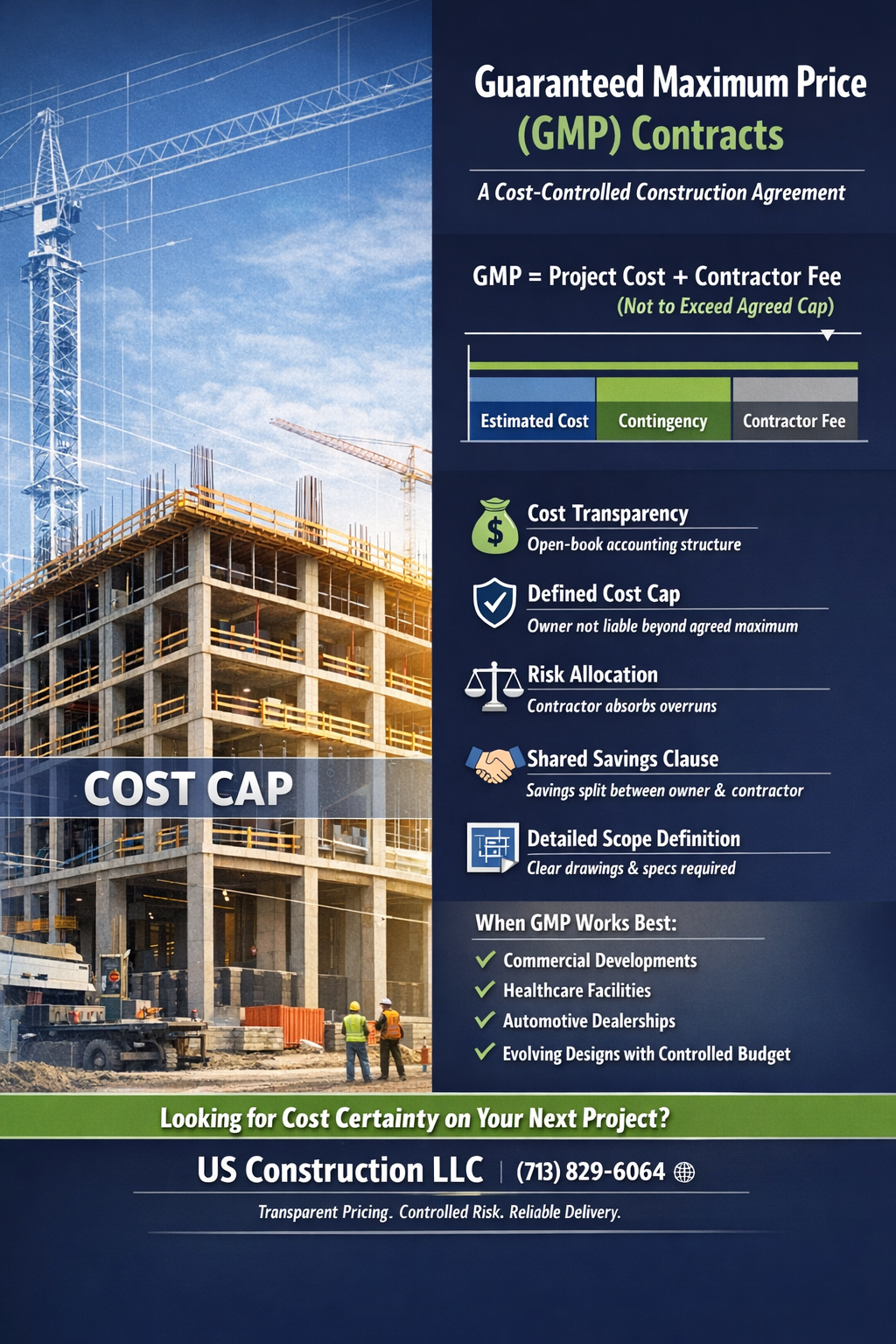
In the construction industry, cost control and risk management strategies improve profit margin. Budget overruns are a significant challenge due to labor and material storage and supply chain disruptions. To reduce these financial exposures, understand what guaranteed maximum price contracts are in construction.
Contractors are shifting from traditional lump-sum contracts to more comprehensive delivery models such as CMAR, Guaranteed Maximum Price (GMP), and Design-Build. US Construction LLC adopts an impactful cost ceiling with flexibility in material and design selection. Advanced pricing models improve predictability, probability, and success rate.
Guaranteed Maximum Price (GMP) Contract
It is a cost-plus construction agreement that includes an accurate project budget and a contractor’s fee within a fixed range. The contractor took responsibility for the cost that exceeded the defined maximum limit. However, the project scope change is not included in this contract.
In technical terms, GMP is a cost estimation agreement with a legally defined upper limit. The property owner has to pay for:
- Construction costs that include labor, materials, and equipment expenses
- Indirect costs like overhead and contingencies
- Contractor’s fee
However, total compensation stays within defined limits. For cost overruns, contractors are responsible for managing exceeded expenses.
Key Principles of GMP Contract
- Price Cap Protection
The owner is sure that the project will require a specific capital investment. The contractor gives a guarantee to complete the construction within a predefined limit. This approach protects the property owner from unlimited financial exposure.
- Cost-Plus Structure with an Upper Limit
In traditional cost-plus contracts, the upper spending limit is not defined. However, in GMP agreements, a structured maximum price range is mentioned. If the project is completed at a low expected cost, the savings are returned to the owner.
How GMP Differs from Fixed-Price Contracts
| GMP Contract | Flexible option with room for design changes and material selection. Cost ceiling and transparent tracking protect the owner. |
| Fixed-Price Contract (Lump Sum) | When prices are fixed from the start, the contractor bears more pricing risk. Moreover, the design and material flexibility are minimal. |
In short, a guaranteed maximum price (GMP) contract is a balanced approach that protects the owner from financial risks with predictable budgeting.
Key Components of a GMP Contract in Construction
A contract is a legal document that covers all the details, including project scope, planning, design, and budgeting. They are mutually agreed-upon conditions for all stakeholders, and everyone is bound to them. Houston commercial contractors properly use the Guaranteed Maximum Price (GMP) as a binding contractual model.
Cost of the Work
This includes a legal document that covers all relevant details, both directly and indirectly, that influence the project’s completion. It includes:
- Direct labor – The on-site employee and the in-house team for design and management. Wages for all staff are considered, including labor compensation in the event of an accident or emergency.
- Materials and equipment – Complete details of the materials, supplies, and equipment used in this construction project. It explains the procurement, delivery, and installation processes with a complete cost breakdown.
- Subcontractor costs – All involved traders, including carpenters, electricians, plumbers, and their payment milestones, are recorded.
- General conditions – Site clearance, feasibility checks, permitting fees, insurance premiums, and project administration expenses are mentioned.
These costs are presented in writing to all stakeholders for any queries or objections. Experienced general contracting companies in Houston, Texas, prefer GMP contracts for transparency and flexibility.
Contractor’s Fee
The secure factor of this agreement is that the contractor’s compensation is separate from the cost of the work. Contractures follow two methodologies to structure their fee, including:
- Percentage-based fee – Contractor charges a fixed percentage of the overall cost of the project, or based on per square foot of area.
- Lump-sum fee – When developers predetermined a fixed management fee for a specific nature and scale of the project.
The chosen structure is decided under background conditions and project needs. Accurate selection protects the resources and mitigates risk factors.
Contingency Allocation
Contingencies budget is the keystone of successful construction projects. It protects the contractor and property owner from unforeseen conditions. In Guaranteed Maximum Price contracts, a specialized section is mentioned for contingency plans.
- Owner contingency – To protect the owner’s needs and expectations, they have reserved a specific budget for scope changes or owner-driven decisions
- Contractor contingency – A specific buffer budget is outlined to compensate for estimating gaps, minor error corrections in design, and team coordination mistakes.
GMP contracts have the advantage of covering allowances and assumptions. This fund is against the project features that are not decided at the time of signing the agreement.
Savings and Shared Savings Clauses
If the final cost is lower than the GMP, the savings are distributed between the contractor and the owner in accordance with a predetermined formula.
- The complete beneficiary is the property owner.
- Shared equally between the owner and the contractor under a pre-defined formula
Shared-savings provisions are a better approach that motivates the contractor to find cost-controlling options. Moreover, they need to comply with strict building codes.
How a GMP Contract Works: Step-by-Step Process
A Guaranteed Maximum Price (GMP) contract requires standardized processes and a structured workflow. Early integration protects resources from costly mistakes and repeated design changes. For the best return, effective team collaboration is essential.
| 1. | Pre-construction Budgeting |
| Early contractor involvement enables accurate budgeting, estimation, feasibility checks, scheduling, and integration of value engineering. The initial cost estimate is later converted into a project budget. | |
| 2. | Open-Book Cost Development |
All projected costs with itemized details are prepared for owner review.
This “open-book” strategy is more transparent and creates financial clarity before locking in the price. |
|
| 3. | Scope Definition |
| When design features are near completion. The contractors’ demand solicits bids from subcontractors. The final project scope has been decided, and plans have been prepared. | |
| 4. | Establishing the GMP |
Once the budget is finalized, the Guaranteed Maximum Price is subdivided.
After the agreement is mutually signed, it protects the owner and contractor from exceeding a pre-defined limit. |
|
| 5. | Construction Phase Cost Tracking |
During construction, regular financial monitoring is essential. Monthly tracking recodes covers:
This ensures a regular tracking system to stay within predefined limits. |
|
| 6. | Change Order Adjustments |
| GMP is flexible enough to tolerate minor changes in project scope and order changes. If the contractor implements changes without the owner’s approval, they are responsible for costs exceeding the maximum price. | |
Comparative Analysis of GMP vs. Other Contracts
A Guaranteed Maximum Price (GMP) contract is professionals’ most preferred choice due to transparent cost tracking and flexibility in order changes. Here, we offer a comparison with other available options to provide clarity and understanding.
| Contract Type | Risk Responsibility | Precision | Flexibility | Best For |
| Lump Sum | Contractor | High | Low | Full project management from design to final finishing. |
| Cost-Plus | Owner | Low | High | A project without a clear scope and evolving with the construction process. |
| GMP | Balanced | High (capped) | Moderate | Complex developmental projects that need fast-track builds |
| Design-Build GMP | Shared | High | High | Integrated project delivery |
Key Differences
- Lump Sum: The total cost of the project is fixed with a standard budget and material specifications. Contractors face more financial risk in this model due to supply chain and market price fluctuations.
- Cost-Plus: The owner has to pay actual costs along with the contractor’s fee. The prices are not ceilings, and there is a higher risk of overrun with this option.
- GMP: Combines balancing of expenses with considerable flexibility for design changes. Expenses are continuously monitored for financial protection.
- Design-Build GMP: In this model, project design and construction are integrated into a single action plan. With improved coordination and efficiency.
GMP often serves as a perfect solution for all project types and natures. It’s a collaborative effort for transparency and quality control.
Advantages of Guaranteed Maximum Price Contracts
It is a structured, systematic process for cost modeling that provides financial protection and project flexibility. Here, we understand its key advantages and why they are effective in meeting customers’ expectations and structural integrity.
Budget Ceiling Protection
The primary advantage of a GMP contract is the security of complying with pre-defined cost estimation. Houston general contractor conducts comprehensive feasibility and real-world application studies to establish the GMP contract. Single body responsibility makes the process fairer and more credible. It protects the owner from:
- Predictable financial boundaries
- Reduced risk of overruns
- Greater customer confidence
- Improved cash flow throughout the project
In a highly competitive construction business, cost-controlling strategies are a reliable way to deliver structures without financial risk.
Transparency Through Open-Book Accounting
In GMP, initial cost estimates are submitted to the owner in an open-book format for review and approval. Each material and supply is presented in an itemized manner with a complete cost breakdown, including:
- Labor wages
- Subcontractor payment plans
- Material specifications and pricing
- General conditions
- Contingencies plans
This level of transparency is effective for customer trust and resolving future conflicts. Moreover, this modeling supports informed decisions and better cost control. The owner is directly involved in budget finalization and gains visibility on where they are used.
Early Contractor Involvement (ECI)
For precise results, GMP contracts are established during pre-construction to secure early contractor involvement. Initial stages enable professionals to integrate cost-controlling methodologies from the design and planning phase. It improves:
- Constructability of the project
- Real-time analyses of cost modeling
- Value engineering adaptation
- Accurate scheduling
By collaborating with the team in the initial phase, practical drawings are developed without costly redesigns and structural errors.
Flexibility for Incomplete Designs
Unlike lump-sum contracts, the GMP enables the builders to start a phased construction method for fast-track completion. The minor amendments to design features don’t affect overall expenses. This contract model offers:
- Fast project completion
- Assist phased or modular construction
- Manage complex commercial projects
- Projects with partial scope clearance
Developers begin construction earlier, while the project team continues to mature in the design and execution phases. It will accelerate overall project timelines.
Incentive Alignment for Cost Efficiency
In fact, under GMP agreements, both the owner and the contractor benefit from cost savings. This initiative speeds up the process and streamlines effective collaboration among all stakeholders. Contractors integrate value-adding strategies to control unnecessary expenses and maintain quality and schedule standards.
When Should Owners Choose a GMP Contract?
The best use-cases for a Guaranteed Maximum Price (GMP) contract are when owners want fast completion, cost control, and flexibility. Below, we mentioned some suitable conditions for the GMP model.
• Commercial Development
Office condos with a mixed-use structural approach require residential-scale facilities and effective parking to meet the needs of business tenants. The GMP contract sets the ceiling on the cost to develop a cost-effective option for a range of populations.
• Healthcare Facilities
Hospitals and medical centers need to install advanced equipment and design features to enhance visitor comfort and ensure regulatory compliance. Contracts are involved at the early stage and plan the necessary activities required for structural integrity and code-compliant constructions.
• Industrial Plants
Industrial-grade development needs cost control without compromising durability. GMP contracts are suitable for manufacturing and production plans to deliver projects quickly within the allocated budget.
• Large-Scale Retail Projects
The franchise of large retail chains needs a standard format under tight timelines and brand standards. Developers find secure approaches, such as the GMP model, for financial predictability.
Houston Commercial Contractor Near Me
Contractors support a Guaranteed Maximum Price contract that offers flexibility of order change without impacting the project budget. Houston corporate developers protect owners from financial risks and maintain accountability with precise action plans.
US Construction LLC adopts a modern construction approach to deliver fast-track projects while maintaining cost control. We specialize in protecting your investment while maintaining schedule momentum.
FAQs
Q 1. Is a GMP contract really cost-effective?
Yes, this strategy outlines a contractual cost ceiling and flexibility of choices. Contractor can easily integrate GMP at the initial stage when the project scope and designs are not finalized.
Q 2. Who is accountable for cost overruns under a GMP?
If the project expenses exceed the contract’s upper limit, the developer is responsible for the cost overrun. This model protects the property owner from financial risk and unexpected delays.
Q 3. Is GMP a more costly approach than a lump sum?
No, it is not effective for each case. In GMP agreements, significant contingencies are reserved to keep the project on track. Moreover, the flexibility and documentation control of GMP are more effective for complex and large-scale commercial constructions.
Leave A Comment