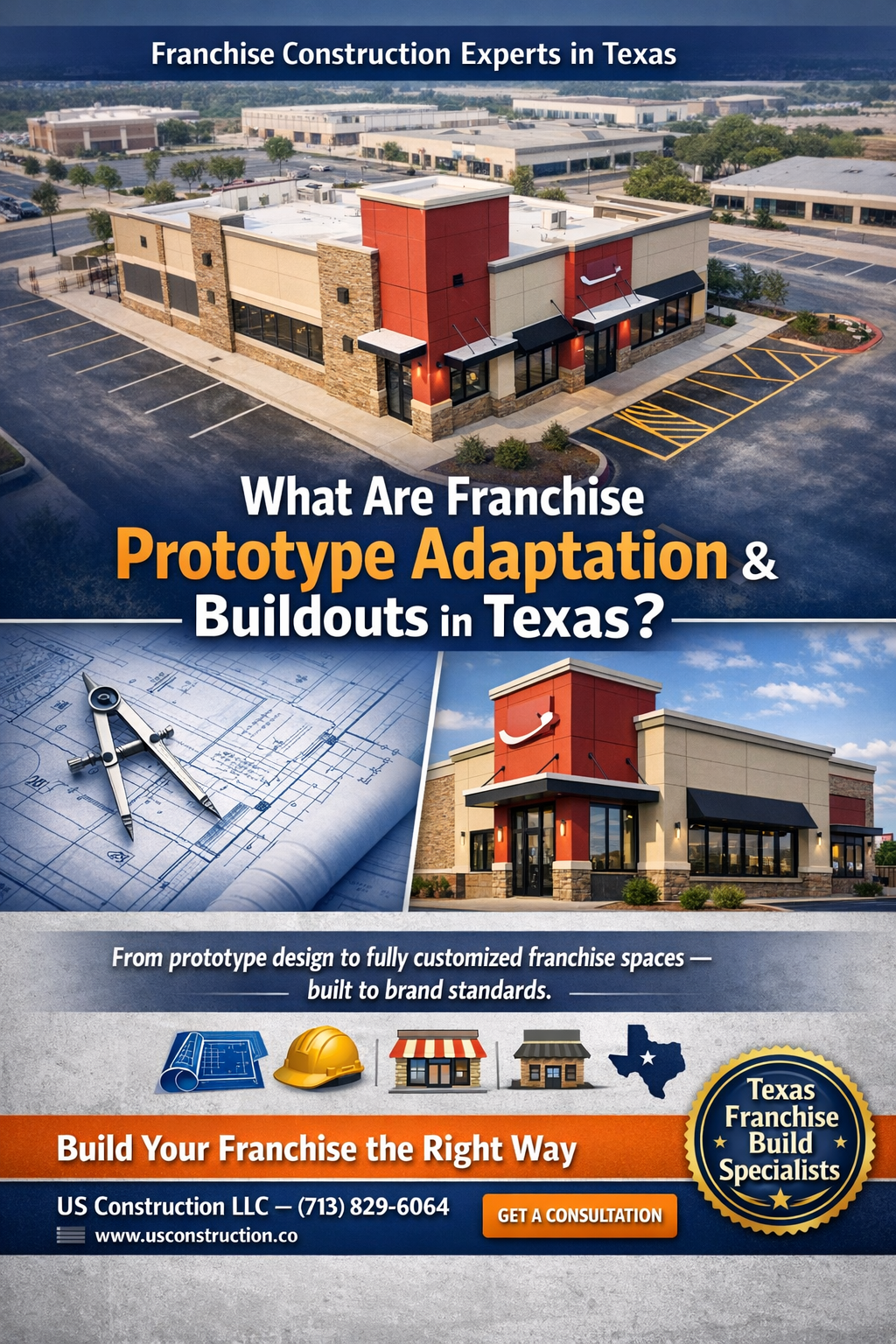
In Texas’s high-growth markets, franchises of fast-food restaurants, retail chains, and medical clinics are expanding rapidly. When a national brand expands its branches, it needs to maintain its brand identity while meeting local construction requirements. To clear this transformation, explore what are franchise prototype adaptations and build-outs in Texas?
Franchise systems are based on the replication of design features, equipment placement, signage standards, and mechanical specifications. However, these prototypes are rarely constructible under actual operating conditions. US Construction LLC delivers consistent branding signals with site-specific adaptation.
What is a Franchise Prototype?
A franchise prototype is a standardized design format for a brand that is replicated across multiple locations. It’s a pre-developed architectural and operational design model to ensure uniformity in construction, equipment placement, workflows, and the customer experience. The major components of the prototype package are:
- Architectural plans
- Exterior elevations and façade design
- Interior finish and material specifications
- Mechanical, electrical, and plumbing (MEP) standards
- Appliance specifications and placement arrangement
- Visual branding elements
- Operational workflow diagrams
What is Franchise Prototype Adaptation?
Prototypes are standardized and need modifications to fit in real-world sites. Franchise prototype adaptation is the process of adjustments in prototypes to make them suitable for site-specific and regulatory requirements. No two construction sites are identical and require adaptations in:
- Local building code and zoning amendments
- Site climate and local conditions
- Utility supply constraints
- Parking and site access
- Landlord preferences
What Are Franchise Build outs?
A franchise build out is the construction phase in which interior structural customization of a prototype design is completed after adaptation. A leased or owned space is fully transformed to meet franchise operational and branding standards. It covers adjustments in:
- Partition walls
- HVAC, electrical, and plumbing systems
- Equipment, fixtures, and signals installation
Why Prototype Adaptation Is Essential in Texas
Franchise expansion is a basic need for food chains, retail, and hospitality businesses. In Texas, strict building codes and environmental standards make prototype duplication challenging. Here, we mentioned some infrastructure variables that impact commercial construction.
State and Local Building Codes
In Texas, the International Code Council develops model codes that are enforced at the municipal level with some amendments. In Houston, Dallas, and San Antonio, different local amendments are implemented with adopted code editions. The major implications are:
- Fire protection system modifications
- Structural recalculations and upgrades
- Energy compliance amendments
- Local inspection codes
Houston commercial contractors understand that a prototype developed for another state may not meet Texas construction codes without modification.
Climate Considerations
Texas’ climate varies significantly by region. Extreme summer temperatures can affect HVAC load calculations and specifications. Moreover, the high humidity requires more precise ventilation and building designs. Windstorms and hurricanes require durable and weather-resistant construction materials.
For heavy rainfall and flooding, advanced stormwater drainage design is necessary. The contractors modify roof assemblies, sealants, and structural wind-resistance elements to address regional climatic conditions.
Municipal Zoning and Permitting
Each city and municipality in the United States has specific criteria for zoning, signage ordinances, and parking. The builders need to incorporate local regulatory requirements into their designs and construction. The major causes of franchise adaptation are:
- Reduce space to follow a fixed layout
- Material unavailability for the specific Façade
- Building height restrictions
- Drive-thru lane limits
- Landscape buffering space
Permit review timelines are the major cause of delays. The project review and inspection schedules vary by region.
Utility Infrastructure Differences
Infrastructure capacity varies by location. The developers have to upgrade the limited electrical service capacity. The reduced water and gas supply pressure, which is unsuitable for commercial construction, is a significant challenge. The professional assesses the existing stormwater detention capacity to inform modifications to the prototype during franchise site development.
Market Demographics and Location-Specific Design
Texas markets are dynamic, ranging from dense urban zones to emerging suburban corridors. Construction trends vary with economic activity and site conditions. Some common prototype adaptations are:
- Large dining area for food points in suburban markets
- Effective parking and lane expansion in drive-thru operations
- Modified storefront visibility factor in dense markets
- Adjusted parking space with local traffic flow
Prototype adaptation should be aligned with local community needs and branding integrity.
Key Components of Franchise Prototype Adaptation
Franchise prototype adaptation is a technical process of adjusting structural, mechanical, and legal aspects to deliver practical building systems across multiple locations. Below, we explain the major components that are reoriented in prototype adaptation.
Site Layout and Structural Adjustments
Commercial builders in Houston, Texas, modified foundation systems for expansive clay soils and adjusted building layouts to make use of available space. Moreover, structural reinforcement is essential to ensure compliance with wind load requirements.
Modifying slab thickness according to workflow and heavy equipment placements. Structural engineers integrate value-added features while complying with Houston building codes.
Mechanical, Electrical & Plumbing (MEP) System Changes
Local energy code requirements and climatic conditions are frequently recalculated for MEP systems. Fire suppression standards and utility service limitations need to be updated in the prototype mechanical specifications. Contractors install:
- High-power rooftop units (RTUs) for increased HVAC demands
- Upgraded electrical panel
- Improved grease interceptor sizing (for fast-food points)
- Modified plumbing systems
These building system modifications are costly, but essential to meet regulatory demands and smooth workflow.
Accessibility and Safety Compliance
In commercial and business-grade developments, Texas federal municipalities enforce strict accessibility, fire, and life-safety codes. Builders upgrade franchise prototypes for the following:
- Modify restroom design for handicaps
- Adjust door hardware specifications
- Ramp slope modifications
- Advanced fire alarm and sprinkler systems
Non-compliance can delay the issuance of a certificate of occupancy and the opening of business activities.
Exterior Facade Modifications
Common exterior adjustments often comply with regional codes for architectural design, wind tolerance, and brand façade standards. Moreover, the energy envelops specifications impact material selection, glazing percentages, and average elevation limits.
Parking and Traffic Flow Planning
The local traffic load, service needs, ADA stalls, and parking space availability should align with municipal standards. Contractors redesign traffic flow through impact studies and modify curb cuts to adjust drive aisle widths. For effective operations and legal compliance, proper planning and site evaluations are essential.
Environmental and Energy Efficiency Standards
The integration of higher-R-value insulation, upgraded glazing, energy-saving lighting, and HVAC systems is an important strategy to reduce the construction footprint. In the United States, greener installations and high-efficiency materials meet energy performance codes.
Common Challenges in Franchise Build outs
Franchise construction is inherently complex. The experts have to blend the business branding signals with local regulatory enforcement. Here, we mentioned some common challenges Houston corporate builders experience in franchise development and build-outs:
Delays in Permitting
The timeframe for commercial constructions varies widely across Texas jurisdictions. Municipal reviews, health department approvals, and fire marshal audits take longer than initially projected. Some setbacks that extend the time period are:
- Incomplete paperwork
- Code interpretation conflicts
- Unclear zoning requests
- Repeated revisions
Permitting delays are common; only experienced construction companies can overcome this challenge.
Site Constraints and Prototype Design
National prototypes are created for a specific site. When developing the same design for multiple locations, the contractors face several issues. The variable dimensions of the lot impact the drive-thru stacking. The available parking space is insufficient for operational needs. In build-outs, the building orientation is not suitable for prototype.
Budget Overruns
With extensive modifications to design specifications, material availability, and equipment grade, the project could overrun the expected budget. Professionals often underestimate the scope of adaptation, the need for repeated design revisions, and MEP system upgrades when structuring the budget.
Moreover, the labor and material costs vary from region to region. Developers need to re-calibrate the project scope after analyzing local engineering and utility conditions.
Franchisor and Local Contractors Coordination
Franchise build outs are complex and require effective collaboration among all stakeholders. Poor communication between franchisor design teams and local contractors can lead to costly rework and delays. Conflicting instructions impact the budget and quality of construction.
Supply Chain Issues
The materials and supplies used in franchise prototype are unique and meet specific specifications. Sometimes builders face availability issues, long lead times, or shipping delays. Business involves specialty lighting fixtures, equipment, and customized signals that can disrupt the commercial build out timeline.
Real-World Case of Adapting a Franchise Prototype
Scenario: Drive-Thru Restaurant in an Urban Texas Market
A national fast-food restaurant wants to open a franchise in Austin with its suburban prototype. Its standard design covers:
- Dual-lane for drive-thru
- 35 on-site parking lot
- Elevated façade with signature architectural features
However, the proposed site has some constraints:
- Smaller working area
- Urban zones have limited parking allowance
- Higher HVAC requirement for extreme temperatures
Franchise Prototype Adaptation Process Covers
- Revise the zoning laws to restructure parking spaces with ADA compliance.
- Site redesign to convert dual-lane drive-thru to a single-lane.
- Mechanical upgrades to upsize the HVAC and ventilation system.
- Façade height adjustment that complies with local guidelines without compromising brand aesthetics.
- Municipal approval for revised design.
The technical expertise of US Construction LLC enables it to obtain permits without major variance requests. Meet timelines, follow brand standards, and ensure operational efficiency. Our practical adaptation offers better business returns and compliance with regional construction standards.
Houston Commercial Contractor Near Me
When franchise construction is managed with local regulations and branding needs, it will improve business success. US Construction LLC is an experienced commercial contractor in Houston, Texas, that understands the unique requirements of each entity. We deliver structures that optimize your operational performance and branding elements.
FAQs
Q 1. What is franchise prototype adaptation?
When contractors modify the standard design and branding features to accommodate specific site conditions, it is called franchise prototype adaptation. They meet business needs and comply with regional building codes and zoning regulations.
Q 2. Why is franchise construction not similar across multiple locations?
First, the regulatory frameworks differ by state and city. Secondly, the site conditions and available resources are different. So, a standard construction design is not feasible across multiple locations.
Q 3. What is the average timeframe for a franchise build out in Houston, Texas?
In average conditions, franchise build-outs take 4 to 8 months from design adaptation through final inspection. However, timelines may vary depending on local conditions, project complications, and regulatory requirements.
Q 4. Who approves franchise prototype modifications in Houston?
Local municipal authorities and the franchisor are the main contributors who approve the design modifications. Moreover, the health department and fire safety authorities approve the safe and practical designs.
Leave A Comment