
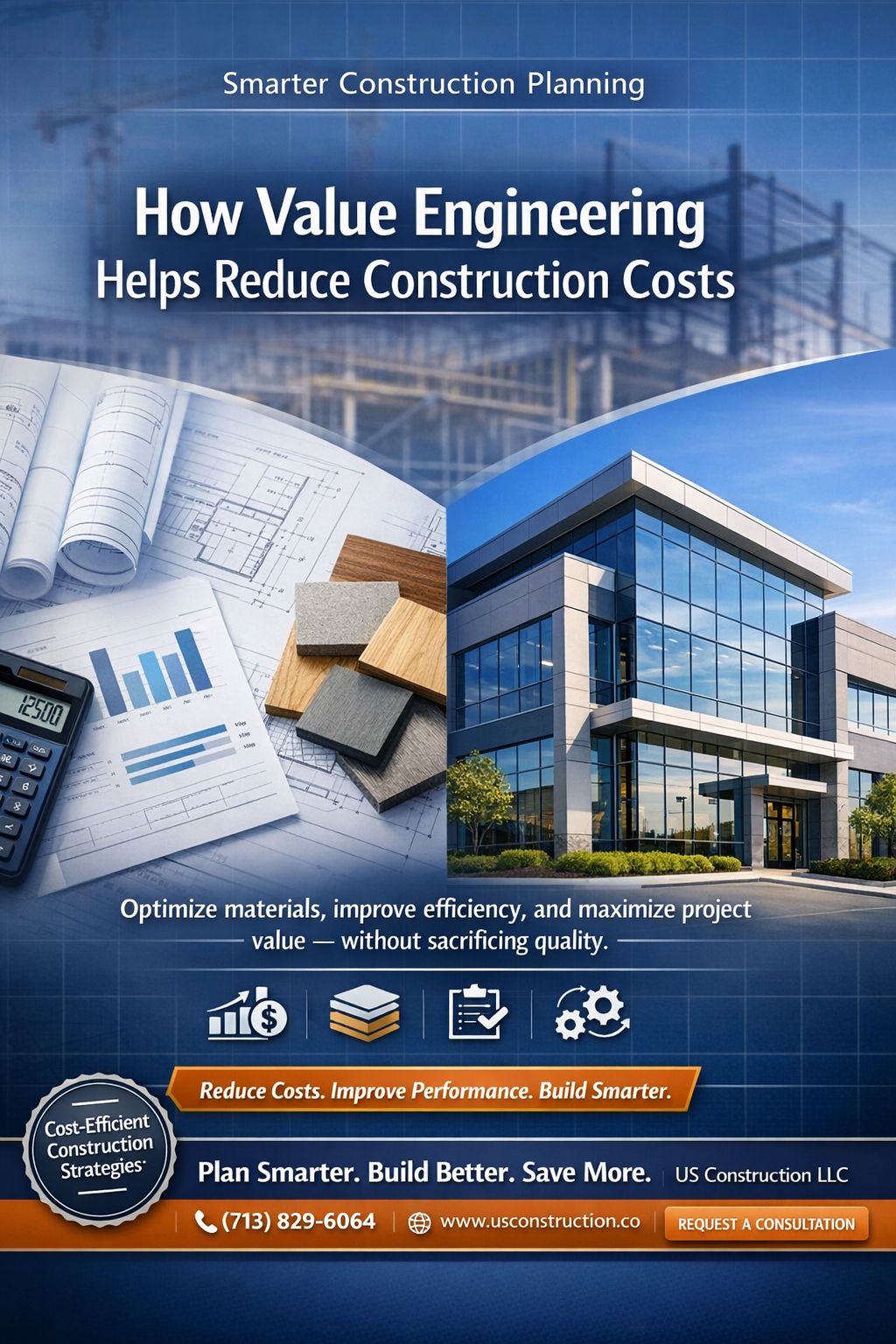
Construction cost control practices have become a top priority to improve profit margins. Rising material prices, labor shortage, and supply chain fluctuations are adding more financial pressure on contractors. Now it’s time to explore how value engineering helps reduce construction costs and deliver high-quality results.
Value engineering is a strategic planning process that identifies alternatives to enhance efficiency, reduce waste, and achieve maximum utilization. US Construction LLC selects materials, systems, and design choices that are of top quality and affordable. Value engineering is the best way to meet a tight budget while delivering a sustainable, profitable project.
What is Value Engineering in Construction?
It is a structured, systematic approach to understanding and evaluating the correlation between the function and cost of construction materials, systems, and design elements. The primary purpose is to identify cost-effective, high-performance substitutes to control project costs.
Experts evaluate the alternatives that are more efficient, durable, and budget-friendly. The value engineering concept is not based on assumptions. Decisions are finalized with comprehensive analyses of long-term objectives and reliable functionality, not just short-term savings.
| Value Engineering | Traditional Cost Cutting |
| Find smart solutions to control costs without sacrificing quality and performance. | Reduces expenses by replacing high-quality materials or designs with low-quality alternatives. |
Key Principles of Value Engineering
- Function-focused analysis: Every element of a construction project is thoroughly evaluated to determine how it performs in real-world conditions.
- Life-cycle cost optimization: The overall lifespan of materials and systems is compared with their upfront cost. Durability factors are assessed at each stage, from design to final maintenance, and the total lifecycle cost is measured.
- Collaborative decision-making: It’s a structured and collaborative effort of engineers, architects, contractors, and stakeholders to identify smarter solutions.
- Performance improvement: Alternative substitutes must have enhanced quality and improved functionality.
In short, value engineering is an innovative approach to reducing construction costs by selecting a smarter alternative after a functional cost analysis.
Why Value Engineering Is Important in Construction
In the construction business, value engineering is an effective strategy to keep costs under control without compromising quality. It is a reliable approach for handling complex projects and advancing sustainability goals.
Reduces Unnecessary Expenses
Value engineering identifies cost-effective alternatives with optimal functionality. Contractors plan material and fixture purchasing within an economic range, with better efficiency. It is a practical way to eliminate wasteful spending and sustain consistent building performance and quality.
Improves Design Efficiency
Developers perform structured functional analysis before finalizing decisions. Value engineering is a systematic process for identifying high-cost products, finding substitutes, evaluating their functionality, and implementing them. It requires effective coordination among architects, engineers, and contractors to get reliable outcomes.
Long-Term Operational Savings
A Houston general contractor understands that top-quality construction is not just about using costly products. In value engineering, professionals evaluate total life-cycle costs, including installation, energy use, and routine maintenance. This results in low-cost projects that are economical to construct and user-friendly to maintain.
Sustainability and Resource Efficiency
Greener construction materials and methodologies are emerging to reduce environmental footprints. Contractors seek energy-conscious installation practices, waste-reduction technologies, and high-performance materials. Value engineering delivers long-term results to meet sustainability goals while also improving cost performance.
Minimizes Budget Overruns
By proactively analyzing flaws in alternatives, we can detect issues early and improve overall project efficiency. Construction companies target methodologies and materials to reduce unnecessary rework and delays.
When Should Value Engineering Be Applied?
Value engineering is a practical approach that can be integrated at multiple stages of a construction project. For the best results and cost control, early-stage adaptation is optimal.
Concept and Design Phase
This is the most suitable time to adjust alternatives at the planning and design stage. At the early design phase, there is more flexibility to modify layouts, materials, and building systems. Moreover, timely decisions and execution reduce the risk of delays and costly redesigns. Small adjustments at the planning stage keep costs under control throughout the project.
Pre-Construction Planning
When a project is in the planning phase, adopting value-engineering materials, designs, and systems increases its success. During project planning, professionals collaborate to finalize schedules and technical specifications. It is a suitable time to assess the product’s performance and cost efficiency before implementation.
During Procurement Decisions
General construction companies in Houston, Texas, integrate value engineering strategies at the material and supply procurement phase. This purchase directly affects project costs and long-term performance. Experts focus on choices that are financially efficient and meet functional requirements.
Budget Constraints or Design Changes
If unexpected setbacks overrun the budget, or legal obligations require repeated order changes. These adjustments create a financial burden and result in material waste. However, value engineering provides a structured framework for analyzing alternatives without affecting the project budget.
Early-stage integration of value engineering is an effective approach. Experts can plan and procure resources to achieve cost efficiency and project control. Once construction begins, design changes or material replacements affect the project’s timelines and budget.
The Value Engineering Process: Step-by-Step
Value engineering follows a systematic way to understand the applicability of substitutes in terms of efficiency and cost control. This organized construction optimization technique identifies the most efficient solutions.
Information Gathering and Project Analysis
Commercial construction firms collect comprehensive data on material and system specifications, cost, and performance parameters. The objective is to select the most suitable option that meets the project’s unique needs.
The process begins with a comprehensive review of project goals, design plans, cost estimates, material specifications, and performance requirements. This stage streamlines a clear understanding of the project cost overview and factors that can lead to overrun.
Functional Analysis of Building Components
Professionals investigate the performance and functionality features of each building element. The basic purpose is to determine the flaws that need to be replaced. They integrate alternatives that can perform the same functions at considerably less expense.
Creative Alternatives and Solutions
The team collaborates to identify the best option for managing the building load and reducing operational expenses. Modern value engineering approaches focus on innovative solutions that reduce project carbon footprints. Also, provide durable structures cost-effectively.
Evaluation of Cost vs. Performance
Sometimes the initial cost is high, but it delivers long-term value and reduces operational expenses. Contractors emphasized long-term durability with minimal replacement and maintenance needs. Options that improve the required functionality and reliability are given more preference.
Implementation and Monitoring
After finalizing the design or material change, the project plans are modified. Experts track the performance at the construction and operational phases. Monitoring of alternatives enables contractors to measure cost savings and efficiency improvements.
Key Areas Where Value Engineering Reduces Construction Costs
Greener construction methodologies improve the durability and optimize the operational life of materials without overburdening the project budget. Here, we mentioned some evolving value engineering strategies and components:
Material Substitution and Optimization
Houston general contractors replace expensive or over-specified materials with eco-friendly, economical substitutes. Common use cases are:
- Synthetic wood is replaced with heavy metallic structures
- Lightweight precast concrete blocks and slabs
- Vinyl or laminate texture flooring as a substitute for hardwood
- Alternative affordable roofing for durability
The goal is to reduce material costs, achieve fast installation, and minimize replacements.
Structural Design Optimization
Improving structural frameworks with cheaper, more reliable systems delivers the same strength while simplifying construction. The effective value engineering solutions are:
- Enhanced beam spacing or column patterns
- Using post-tension concrete structures
- Simplifying framing with reduced mass and high capacity
- Control unnecessary installations of load-bearing components
These alternatives regulate safety codes while controlling material and labor expenses.
Construction Method Improvements
Innovative construction methodologies to save time, reduce waste, and improve efficiency. Developers suggest some cost-effective alternatives:
- Prefabrication or modular construction
- Standardizing design and installation protocols
- Speed-up construction sequencing
- Using advanced techniques for fast completion
Standardized formats control the time and effort required for repeated design and planning.
Energy Efficiency and Cost Reduction
High inflation and rising utility costs are driving demand for energy-efficient materials and installations. These high-performance options have a slightly higher initial cost but offset it with lower maintenance and fewer replacements.
- High-efficiency climate control systems
- Improved sealing and glazing reduce electricity billing
- Smart LED lighting controls operational costs
- Solar panels are installed on rooftops
The improved life cycle of greener products regulates the maintenance expenses.
Space Planning and Functional Efficiency
Contractors design effective planning strategies to maximize space utilization and reduce building size and construction costs. Use cases are:
- Mixed-use construction layouts replace single-use spaces
- Efficient ventilation models are integrated at the planning stage
- Compact structural parts improve service areas
- Reducing waste of materials
Smart construction designs improve utilization rate and reduce overall expenses.
Real-World Examples of Value Engineering in Construction
Value engineering has measurable results and practical applications. Experts develop strategies that apply to real-world cases rather than relying on guesswork or assumptions. Here, we present practical examples of value-engaging solutions that enhance a property’s long-term value without financial burdens.
Material Substitution
A commercial building requires high-end flooring that is expensive to install and costly to maintain. Contractors use synthetic wood for flooring with outstanding appeal and long-lasting durability.
Result: With advanced, cost-efficient material selection, they reduce construction costs by 20–30%.
Structural Redesign
The customer suggests building an office space with an over-engineered structural framework. Our experienced professionals review the building’s load requirements and eliminate unnecessary installations. Proper studies enable the builders to optimize the need for the framework.
Result: Professionals reduce 12–18%, resulting in lower material and installation costs.
Energy-Efficient System Upgrade
A large-scale distribution center initially planned to install standard HVAC equipment. Using value engineering approaches, contractors propose high-capacity systems with smart climate controllers to reduce operating expenses.
Result: Customers save 25–35% annually on electricity expenses by installing high-efficiency systems. Indeed, the initial cost was slightly high, but switching to low electricity billing.
Construction Method Modification
A large project originally planned to perform all activities on-site. It takes more labor and time to complete the project. Using prefabricated components and a modular construction approach reduces the timeframe while maintaining excellent quality.
Result: Labor costs lowered by 10–15%.
These practical examples demonstrate the real-world cost-controlling feature of value engineering methodologies.
Houston General Contractor Near Me
The construction industry is transforming to deliver high-efficiency structures with minimal environmental impact and controlled costs. US Construction LLC integrates smart construction methods and materials for reliable performance, quality, and sustainability.
Value engineering is a multi-stage process for identifying, testing, and implementing cost-effective solutions in the construction industry. Contact Houston general contractor to experience the most effective and least expensive smart technologies.
FAQs
Q 1. What is value engineering in construction?
Value engineering is a systematic process that analyses basic needs and functions, and suggests economical, long-lasting options. It is completely different from the traditional cost-cutting approach, which compromises the quality to reduce expenses.
Q 2. How does value engineering control unnecessary costs?
Construction is a complex process and requires practical approaches that control costs while maintaining building quality. Experts analyze the functionality and performance requirements to select alternative materials that can withstand building loads.
Q 3. What is the best case to implement value engineering?
The best way is to integrate value engineering approaches from the initial designing and planning phase. Early implementations reduce cost reworks and provide maximum flexibility of choice.
Leave A Comment