
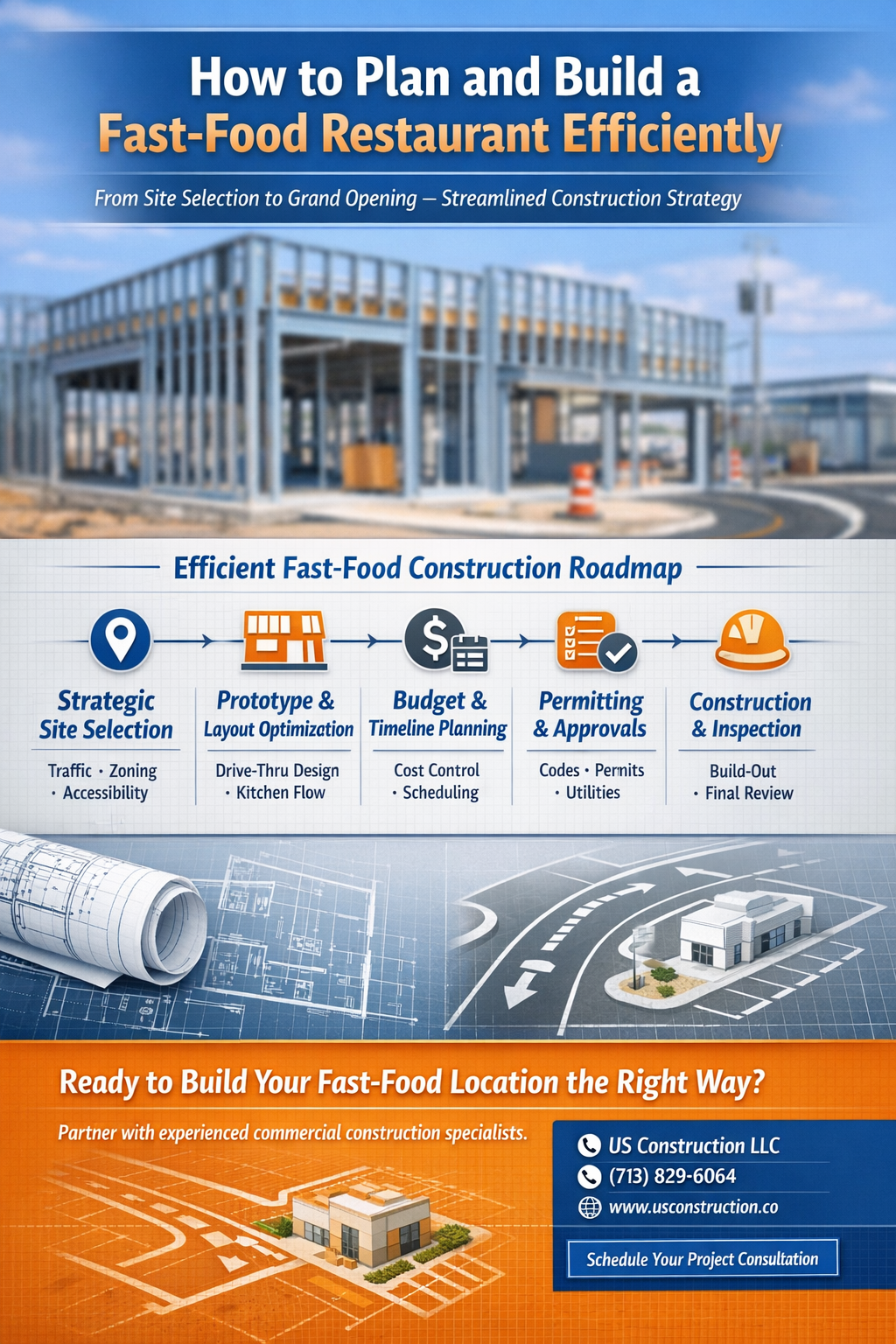
The emerging trend of quick-service dining completely transformed the fast-food industry. People nowadays want consistent taste and convenient seating. The success factor of this business depends on how to plan and build a fast-food restaurant efficiently. Poor kitchen design, construction delays, and regulatory issues reduce profitability.
US Construction LLC follows a structured planning and construction process to control expenses, address regulatory complexities, and optimize staff productivity. We select a suitable kitchen design for workflow, install highly efficient equipment, and a system that can be expanded with future growth. Contact us if you need a new fast-food structure or to continue a franchise.
Define Your Fast-Food Business Concept and Strategy
A clear business concept is essential for the successful construction of the fast-food restaurant. Contractors understand the basic needs of restaurant construction, including their target customers, which products they serve, and how to compete with others. The concept of their business is represented in their construction style and material selection.
1. Target Market and Customer Demographics
Understanding your target customers’ desires and preferences increases your chances of success. In fact, the fast-food business depends on understanding market trends and customer behavior.
Location-Based Trend
- Study the nearby community population and existing businesses
- What is the customer flow peak time around your point?
- Assess the competitors in that area and market gaps
Dining Behavior and Spending Patterns
- Do buyers prefer delivery speed, price, or quality?
- Common age group of the customers.
- How much do they spend on a single visit?
- How often they repeat purchases
When you understand your customers’ behavior, you can adjust your prices, menu, and service style to meet their expectations.
2. Menu Concept and Service Model
The menu diversity and service style define the kitchen layout, staffing speed, and overall construction cost. Reliable Houston commercial contractors select a suitable model that enhances operational efficiency.
Menu Structure
- Limited menu: If you follow a limited menu for your business, it will speed up delivery time, simplify operations, ensure consistent food quality, and incur fewer expenses.
- Expanded menu: It will appeal to more customers, but it is hard to manage and has a slow serving speed.
The best approach is to target the high-demand, high-margin items to grow your business’s profitability and customer satisfaction.
Service Style
- Drive-thru: It will improve customer flow for those who focus on speed and convenience. They cover a high-volume design with specialized features.
- Takeaway only: When the proposed land for a fast-food restaurant is limited, this service model is a perfect fit.
- Dine-in: For better customer experience and improved brand identity.
- Hybrid model: Maximum flexibility of menu and serving style. However, you need special focus on workflow planning
The fast-food service model should align with customer preferences, local market trends, and traffic flow.
3. Brand Positioning and Competitive Advantage
The brand identity of any fast-food restaurant shapes customers’ expectations and sets it apart from competitors. For long-term profitability, the business should focus on its competitive advantages. Here, we discuss some common strategies:
Pricing Strategy
- A budget-friendly menu that comes in a range for everyone is the most appealing factor.
- Value meals with special offers and combo pricing.
- Align pricing with customers’ expectations
Speed Service with High Quality
- Standardized items can meet ultra-fast service
- Higher-quality menu requires longer wait times
- Define your target customers’ priority and outline operations accordingly
A successful fast-food restaurant needs complete synchronization between its construction and its business concept. Involved an experienced Houston general contractor who assists you from site selection and kitchen layout to staffing and marketing.
Financial Planning and Budget Structuring
Comprehensive financial planning and budgeting are essential to keep construction projects on track. Without a clear funding strategy, there is a greater risk of delays and budget overruns. Effective restaurant financial planning reduces risk and uses resources wisely.
Startup Cost Breakdown
A detailed cost estimation enables dealing with unexpected financial strain and managing tight timelines. The cost of construction depends on several factors. Join us to explore common expense categories for fast-food build-out.
| Land or lease |
|
| Construction and Build-Out |
|
| Equipment |
|
| Licensing and Compliance |
|
| Staff Training |
|
Funding Options
After analyzing overall expenses and budgeting, the next step is selecting the right financing structure. Mostly, the property owners avail a combination of funding sources to manage cash liquidity throughout the project. Some funding sources in Houston, Texas are:
| Loans |
|
| Investors |
|
| Franchise Financing |
|
Cost-Saving Strategies
Experienced builders adopt expense-control strategies without compromising construction quality. Innovative technologies improve financial efficiency and retain customer satisfaction.
- Control utility billing by installing energy-efficient equipment
- Select a kitchen design that gives a smooth flow and speed in operations.
- Start with a limited menu to manage cash flow
- Purchase raw material in bulk to avail of discounted prices
- Adopt phase construction to reduce your impact on surrounding businesses
Strategic spending plans are essential to keep fast-food restaurant construction up to date without overburdening the investor.
Choosing the Right Location for Maximum Profitability
Location is one of the powerful drivers for success in the fast-food business. This factor dominates the best menu, high branding, and service model. They will struggle hard if they choose a poorly accessible area. An attractive location has consistent customer flow and operational convenience.
Traffic Flow and Visibility
- High passerby or vehicle flow appeals to more buyers
- Connected with main roads improves visibility
- Presence of commercial areas like offices, schools, and shopping centers increases customer flow
Accessibility and Parking
- The buyers prefer the food point with easy entry and exit for vehicles
- The parking space should be effective in handling peak-hour pressure
- Separate parking arrangement for drive-thru lanes
Nearby Competition Analysis
- Conduct a local market survey to analyze the competitors with similar menus
- Market saturation helps to select a business plan
- Clustering points like food hubs or courts attracts more visitors
Zoning and Regulatory Considerations
- Confirm the property is registered and approved by the local authorities
- Check the accreditation of the construction plan with local zoning laws
- Verify the drive-thru operation permissions
Future Growth Potential
- Planned fast food restaurant development is effective for future expansion
- The nearby population growth pattern defines future growth
Selecting suitable land for a fast-food business can yield a better return on investment. It will help you position your business to lead with smart strategies and careful consideration.
Legal Requirements, Permits, and Compliance
Legal compliance is essential for commercial construction; it will boost your brand identity and protect you from legal penalties. The ignorance of regulatory requirements can result in costly delays and penalties. A clear understanding of the legal approvals required for fast food restaurants ensures a smooth, timely launch.
Business Registration
- Register your business with local authorities
- Acquire tax identification and working approvals
Health Department Approvals
- Kitchen inspection is essential before operations start
- Verification of health and hygiene standards
- Regular audits and compliance checks
Food Safety Certifications
- Staff certification is important for safe food handling
- Verification with proper sanitation and storage procedures
Fire Safety and Building Codes
- Emergency exits and a fire protection system are crucial
- Ventilation and building codes approvals
Environmental and Waste Management Regulations
- System for grease disposal and drainage
- Separate structures for waste segregation and recycling
- Noise and air emissions control regulations
Construction of a fast-food restaurant involves complex and strict legal regulations. General and commercial construction companies have teams of legal professionals, architects, and regional compliance specialists. They collaborate to meet the safety and operational standards of the final structure.
Smart Restaurant Layout and Kitchen Design
An efficient restaurant design and kitchen space are the backbone for fast operations and consistent food quality. It will also improve staff productivity and enhance the customer experience. All the design features support smooth and logical arrangements from food preparation to order delivery.
Workflow Optimization Principles
The workflow of fast preparation and delivery should be smooth and support natural movement without unnecessary steps.
Order Flow Efficiency
Construction companies in Houston, Texas, prefer a linear path for order placement to delivery. They segment the structure into work zones to reduce distractions. Also, clear communication between front-of-house and kitchen staff helps manage the pace of work.
Staff Movement Minimization
For a smooth workflow, machines and ingredients are strategically arranged. Segmentation of the working area controls unnecessary cross-traffic between workstations. Proper labeling of prep, cooking, packing, and cleaning sections assists the staff.
Kitchen Equipment Placement Strategy
Professional contractors understand the work sequencing in a fast-food restaurant to improve speed, hygiene, and staff coordination. The standard model is:
Preparation → Cooking → Assembling → Delivery
- Prep area: The basic ingredients are arranged with easy access to washing and cutting are
- Cooking area: It covers electric fryers, ovens, and grill stations
- Assembly station: Packing or serving of food for final dispatch
- Service zone: Delivery counter for dining and take-away section for drive-thru
These structured arrangements reduce distractions in the workflow and ensure high-quality results.
Customer Experience Design
For a pleasant customer experience and a comfortable developer, focus on the following factors:
| Queue Management |
|
| Seating Layout |
|
| Drive-Thru Design |
|
A well-designed fast-food restaurant with a proper structure of customer flow and high-volume operations.
Fast-Food Restaurant Contractors Near Me
A successful fast-food business is not just about food quality; the design and location of the building also play equally important roles. Houston commercial contractors strategically planned and executed construction that streamlined operational efficiency and customer experience.
US Construction LLC provides the best model aligned with your business concept, legal requirements, and target market needs to deliver maximum return. Our experts thoroughly plan to reduce risk factors and improve future decision-making.
FAQs
Q 1. What is the average cost range to build a fast-food restaurant?
The cost of developing a fast-food restaurant depends on location, size, legal complications, and the appliances required. The major expenses include land, kitchen appliances, licensing, and staffing. The small takeaway construction requires smaller investments, while full-service or drive-thru units require higher budgets.
Q 2. How long does it take to construct a fast-food restaurant?
Construction timelines also vary with design and size complications. Moreover, the permitting process required the services of experienced professionals, including their fees and time spent collaborating. Reliable contractors have an in-house team to ensure timely completion and effective collaboration.
Q 3. What permits are required in Houston to develop a fast-food restaurant?
The property owner must obtain business registration approval from local authorities. They have to follow the codes and audits issued by the health and food department. Environmental and waste management approvals are essential for branding and customer satisfaction.
Q 4. What design is best for a food point’s operational efficiency?
The best design model for a fast-food point covers proper segmentation for food preparation, cooking, packaging, and delivery.
Prep → cook → assemble → serve
This arrangement should be logically designed to minimize distractions and ensure a smooth workflow.
Leave A Comment