
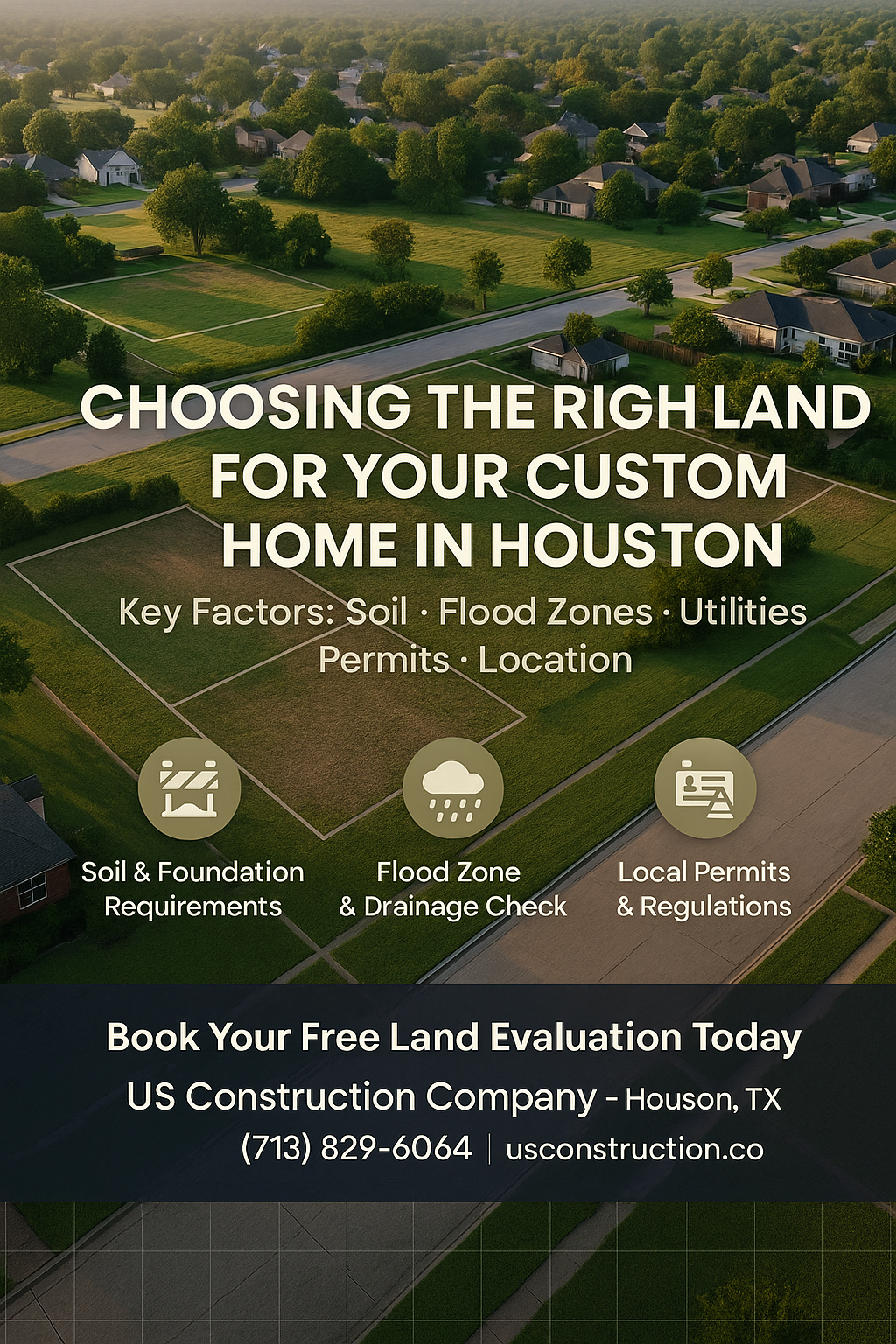
In custom home development, selecting suitable land is the most crucial step. The location and topographical features of the lot affect construction costs, design, durability, and resale value. Join us to understand how to choose land for your custom home in Houston, Texas.
Houston provides affordable land prices than other United States cities. However, its clay soil and heavy rainfall require special considerations from the foundation pouring onward. Understanding your lot’s features protects your investment and safeguards you from costly issues later. US Construction Company evaluates your custom home’s safety concerns, drainage, and utility supplies from the start of construction.
This blog post focuses on how to choose suitable land for your dream home development that meets your preferences, goals, and budget.
Houston’s Unique Land and Soil Conditions
Building a home requires more than the aesthetic appeal of the surroundings. For long-term stability, hire local Houston general contractors who understand the soil nature to craft suitable foundations and reliable structural features.
Houston’s Soil Types
The expansive clay soil of Houston is a challenging factor in delivering durable custom home construction. This type of soil quickly absorbs water in the rainy season and shrinks in hot weather. The constant contraction and expansion create drainage issues and cracks in poured concrete structures.
Experienced contractors incorporate design features and reinforcements during foundation development to address clay soil conditions. Here, we list some common foundation types for Houston’s soil.
| Stable soil | A cost-effective standard-grade slab-on-grade foundation is reliable on stable land. |
| Highly expansive clay | Special engineered structure with a network of deeper piers to mitigate high moisture content in soil. It is the most expensive foundation type. |
| Sandy or mixed soils | It needs precise soil compaction and installation of a drainage system. |
Soil composition studies are essential for selecting a suitable foundation type that does not require rework or future repairs.
Soil Testing Requirements
Understanding soil structure, chemical composition, and physical characteristics is vital to crafting long-lasting structures. Construction companies involve soil scientists and geologists to perform soil sampling and testing to identify:
- Soil nature and water holding capacity.
- Load-bearing strength without deforming.
- Drainage properties.
- Required soil stabilization.
Indeed, estimating soil condition reduces the risk of costly errors. Developers plan the design features and framework based on these preliminary examinations.
Request a Soil Test Before Land Purchase
Before purchasing land, the reliable Houston home contractors conduct soil analyses of the proposed site. To evaluate:
- The land is around a flood-prone zone, and what type of soil is there? Is it soft, uneven, or compacted?
- How many stories of a custom home are you planning for?
You may find out if the lot is suitable for construction and how much the groundwork will cost. Also, evaluate the site preparation costs before purchasing.
Evaluate Flood Zones and Drainage Systems
In Houston, heavy rainfall poses a threat of flooding in low-lying areas. So, the top residential construction companies help customers select suitable land with the fewest structural failures. In the past, the devastating hurricanes like Harvey and Imelda caused significant damage. Now, the developers are giving prime focus to flood-prone areas.
How to Read FEMA Flood Maps
An accurate flood-zone evaluation is an essential factor in constructing stable, long-lasting home structures. Houston municipal authorities published Flood Insurance Rate Maps (FIRMs) to categories land by flooding risk.
- Zone X (Lower Risk): Ideal for residential construction; frequently exempt from the requirement for flood insurance.
- Zone AE (Extreme Risk/100-year flooding zone): Tighter building regulations and catastrophe coverage are required.
- Zone VE (Coastal High Hazard Areas): Rare in Houston, but very dangerous; raised construction structures are required.
In fact, the competent developer can find the exact interpretations. The vulnerability of land to flooding is determined by comparing the Base Flood Elevation (BFE) with the natural terrain gradient. If the land is located within the floodway, leave it; it would be highly risky to build a custom home there.
FEMA data values are altered after major storms. So, it’s better to contact the relevant authorities for accurate information.
Floodplain Building Requirements
Reliable contractors understand the strict provisions of the Harris County Floodplain Management Regulations. They also incorporate the City of Houston’s floodplain construction codes that may include:
| 1 | Place the foundation of the custom home at least 1–2 feet above BFE; it is an essential requirement. |
| 2 | Get certification for Elevation, prepared by experts and licensed surveyors. |
| 3 | Conduct studies to find out the most suitable foundation design. Commonly elevated slabs and pier-and-beam are effective. |
| 4 | Proper soil grading and drainage system installation |
US Construction Company is the seasonal general contractor in Houston with more than 40 years of experience. We identify land issues early and communicate effectively with the homeowner to avoid budget surprises and delays.
Drainage Considerations
Terrain gradient, topographical features, and soil moisture index affect construction and structural durability. If the natural drainage system of a selected lot is poor, you will have to spend extra money to develop water channels and implement run-of-the-river mitigations.
- Natural Drainage Flow
Every terrain has a specific pattern of surface slope that determines its drainage quality. If the selected area has an inward flow of water, it will damage the foundations. The contractor’s integrated plan to develop French drains, resurface the land, and install retaining barriers protects the building.
- Detention Ponds
In the Harris County area, the on-site detention pools or collection zones are required to make the lot usable. It will increase construction footprint and costs, and lengthen permit approval timelines. Experts analyze whether a personalized detention pond is needed or whether one already provided by the subdivision can be used.
- Lot Elevation vs. Street Elevation
A well-draining lot is commonly at a higher elevation than the street level. This feature supports natural water drainage and is suitable for the economic construction of a custom home in Houston. Competent contractors can analyze such features with a physical examination of the proposed land.
Zoning Laws, Deed Restrictions, and No-Zoning System
Although Houston is the biggest city in the United States, it lacks any zoning regulations. Therefore, land selection becomes riskier and more challenging for homeowners. Builders have more flexibility when there is no zoning. However, they must strictly follow local regulations and the permitting process.
Houston’s “No Zoning” Approach
In fact, Houston’s lack of zoning creates additional challenges for construction companies. There are no proper boundaries for residential, commercial, or industrial settlements.
- More chances of violating natural resources.
- Mixed-use construction is flourishing rapidly.
- Future conflicts with neighboring property owners are increasing.
Municipal authorities, building codes, and deed restrictions primarily regulate land use. From a builder’s standpoint, a no-zoning scheme provides flexibility for bespoke residential designs. However, they have to outline actionable plans to mitigate future concerns about traffic, property value impacts, and renovation complications.
Deed Restrictions and HOA Rules
In Houston, the land development projects are controlled by HOA (Homeowners Association) regulations and local deed restrictions. These are considered alternatives to zoning for regulating property and neighborhood rights.
- Architectural Guidelines
HOAs outline exterior finishing grades, roofing materials, maximum building height, architectural styles, and brick quality. The reliable contractors have a complete understanding of and are up to date on current design compliance requirements.
- Setbacks
Deed restrictions streamline the exact distance of the property line, measurements for streets, sidewalks, and easements, and layouts. These setbacks impact the construction process and available area.
- Home Style Limitations
Some communities restrict the development of multi-story residential buildings. Dimensions for the garage and outdoor space. They also invent with a minimum area for a custom home. Houston residential contractors follow all these guidelines to avoid HOA disputes.
Permitting Requirements
The contractor must comply with Houston’s local regulations and obtain permits for electrical, plumbing, and mechanical installations. Drainage and soil grading certification enables the resolution of water-related damages. Similarly, the floodplain development permits a secure custom home in sensitive areas.
Location, Neighborhood, and Access Factors
After verifying the structural stability of the proposed land, the contractors evaluate the surrounding features and the building of your custom home. The convenience of the tenant depends on the availability of transport systems, hospitality, schools, and utilities.
-
Commute Times
Houston’s traffic patterns impact the homeowner’s access to highways and other transportation hubs. Land near -10, Beltway 8, 610 Loop, or 59/69 offers direct access to the city’s major roadways, reducing commute time. Many suburban options take longer to reach the city’s exit points.
-
School Districts
School districts affect the value of properties in proximity and those requiring less drive time to reach. The central districts are Spring Branch ISD, Cypress-Fairbanks ISD, Katy ISD, and Fort Bend ISD.
-
Local Amenities
Moreover, the presence of Grocery stores, medical centers, and recreational facilities enhances the land’s selling price. Houston home builders help customers find lots with easy access to the necessities of life.
-
Utility Availability
Similarly, the previous installation of utility supplies makes the custom home construction simple and effective. The land in the outskirts or semi-rural suburbs has comprehensive water, electricity, and gas connections. In fact, construction costs are reduced if the selected lot has direct connections for sewer lines and other facilities.
-
Future Infrastructure Development Plans
Houston is rapidly growing. However, the no-zoning principle of construction can positively or negatively impact the worth of your custom home. Competent residential construction companies have a deep understanding of local trends and people’s preferences. They can guide you well in selecting and purchasing land.
Determine the Right Lot Size, Shape, and Topography
Choosing the ideal lot involves more than just geography. It should fit your budget and support your daily life and home design. Construction feasibility, visual appeal, and long-term expenses are all influenced by lot area and topographic position.
Lot Size Based on Home Design
The design and architectural features of the custom home depend on the available land area.
- One-story homes need extensive dimensions of the land to design the complete factors of a custom home.
- Two-story homes can provide adequate living space in a limited footprint.
- Outdoor Amenities are the basic needs for an average family lifestyle. It may cover the garage, siding, swimming pool, and outdoor landscaping.
As contractors, US Construction experts assess available land and design a complementary layout to achieve a practical approach within the allocated resources.
Lot Orientation
Natural light, consumption of energy, and convenience are all impacted by the lot’s position:
- Homes facing north: Consistently experience calmer light, which is perfect for lowering the interior temperature during Houston summers.
- West-facing homes: They may need window insulation or shading techniques due to the intense afternoon sun.
In addition to increasing ambient light and improving recreational areas, proper orientation can reduce cooling costs.
Sloped or Flat Land
Topography features and surface gradients create issues in groundwork and site preparation.
- Flat lots: less excavation work, less expensive grading, and easier to construct on.
- Sloped lots: The contractors need to provide extensive foundation work and drainage channeling that increases the construction cost.
Local Houston contractors can effectively mitigate such challenges and craft your dream custom home. However, the timeline and budgets vary depending on the lot’s location and natural features.
Budgeting for Land and Construction Costs
Buying land is the first investment towards having a desirable custom home. It is better to involve the developers from the land selection process. They understand the fundamental principle that the land should meet to reduce construction costs without compromising structural quality.
Hidden Costs Buyers Don’t See
The unexpected expenses that are associated with land purchase without examining the background factors are:
- Land Clearance: Making the land feasible to move the heavy machinery for the developmental process.
- Tree removal: Indeed, the cutting of large trees requires permitting, and experts service that increase the overall cost.
- Utility Connection Fees: If you purchased and don’t have utility supplies, you have to wait for a considerable time for installations and have to pay hefty fees.
- Soil stabilization: For wet soil, the contractors should conduct chemical and mechanical stabilization treatments to prepare the land for construction.
Get Construction Loan
If you are planning to finance the construction of a custom home. The location and worth of the lot impact the loan retrieval process.
- Land value: Lenders provide payment based on the overall worth of the land. Moreover, the success factor in obtaining financing varies with the lot’s market price.
- Appraisal impact: The land size and surroundings impact the interest rate.
Hire reliable Houston home contractors to streamline the paperwork for a construction loan. They have the expertise to increase the chances of receiving financing.
Work With a Houston Contractor During Land Selection
Land selection is a professional choice that affects construction, site preparation, and long-term return. Early collaboration with a certified Houston contractor reduces the risk of costly mistakes. A specialist evaluation provides critical information:
- Look for warning signs, including shaky ground, inadequate drainage, or issues with utilities.
- Determine the precise cost of foundation and installation based on the kind of ground, drainage, and flood protection requirements.
- Avoid expensive errors that may result from purchasing a lot that is either practically impossible to construct or necessitates costly remediation.
Contractors assist buyers in making well-informed land purchase decisions. They have the expertise to evaluate the land and identify its flaws.
Final Checklist: How to Choose Land in Houston
Houston Home Developer Near Me
A stunning custom residence in Houston starts with choosing the perfect land. Proper property estimation secures your investment, promotes structural safety, and avoids unforeseen expense. Houston home developers evaluate the surroundings and soil features of selected land to improve the durability of the building.
Do you require a professional assessment of your property before making a purchase? Contact US Construction Company to avoid expensive mistakes.
FAQs
Q 1. How can I determine whether my purchase lot in Houston is feasible for construction?
The nature of the soil and the land location in the floodplain area are the first steps. Next come the surrounding features, such as access to highways, schools, and utilities.
Q 2. Is a soil assessment required before purchasing land?
Indeed. Essential details on water drainage specifications, soil quality, and construction constraints can be found in a topographical report. Doing a soil test before finalizing avoids costly construction-related surprises.
Q 3. What impact do Houston’s floodplains have on custom home construction?
The need and extent of groundwork vary with the land’s geographical location. In flood-prone areas, contractors construct elevated foundations to protect against water-related damage.
Leave A Comment