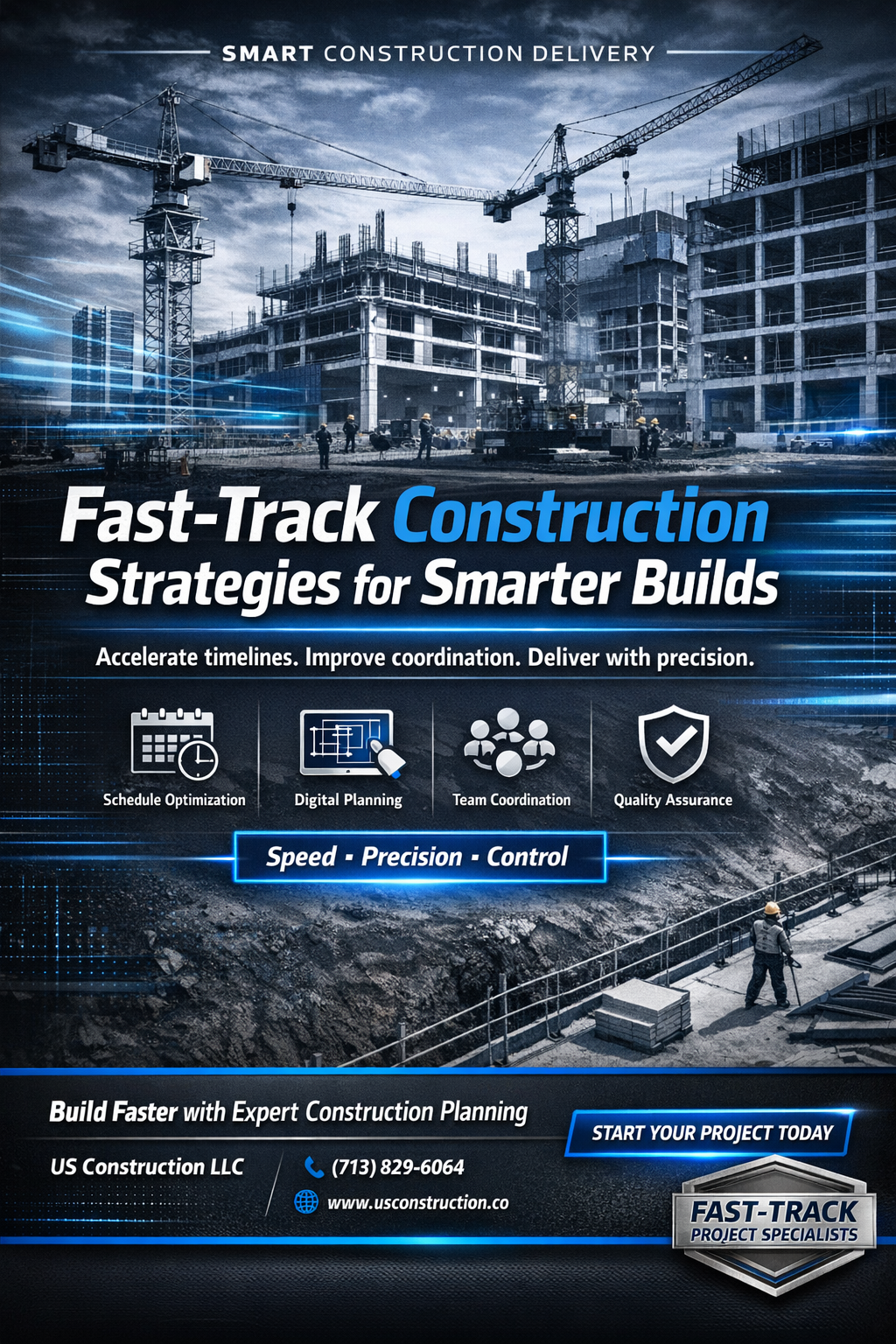
Fast completion of construction projects improves a company’s market reputation and financial pressures. Contractors are focusing on fast-track construction strategies for smarter builds that increase profitability and reduce risk exposure.
The primary driver of fast-track construction is the rising cost of project delays. Extended schedules increase labor costs and the risk of market fluctuations. Every single day of delay counts as a loss of business opportunities for the customer. US Construction LLC understands the value of time and delivers on-time completions.
What Is Fast-Track Construction?
Fast-track construction is an advanced project delivery method that blends design and execution stages to shorten timeframes. Contractors start permitting, material procurement, and team collaborations at early stages rather than waiting for approvals and finalizations.
Contractors prefer phased construction approaches over a standard sequence. For instance, they start groundwork and land preparation, while structural or interior design is still in progress. Proper management leads to faster completions without sacrificing final structure quality.
| Traditional Construction | Fast-Track Construction |
|
|
The primary goal of fast-track strategies is to reduce the completion time while maintaining safety, quality, and efficiency targets.
How Fast-Track Construction Works in Houston, Texas
Faster construction completion enables the customer to start their business activities earlier, thereby generating revenue. How can the contractor and customers overlook this effective adaptation? Only experienced general contractors in Houston, Texas, carefully plan their activities and make wise decisions to meet fast-track construction requirements.
Parallel Workflow Planning
They managed their operational schedules to perform multiple tasks rather than waiting for a single stage to complete. Builders deliver activities into work packages that can begin independently. Including:
- Site clearance and land preparation can be started, along with finalizing the design
- Foundation work can be completed when experts are reviewing interior layouts
- Plan material procurement with the completion of construction drawings
This concurrent project scheduling techniques help control idle time between phases.
Early Procurement Strategies
Contractors have experience with materials and equipment that require a long lead time to reach the project site. So, start procurement requests early to avoid delays later. Some early procurement items are:
- Structural steel or precast concrete blocks
- HVAC systems and mechanical appliances
- Customized façade or roof glazing
- Heavy-duty equipment needs a lengthy lead time for manufacturing
Early purchasing of specific materials and supplies reduces the need for scheduling expansions. However, the developers should make confident design decisions to prevent costly order changes.
Supports schedule compression but requires
Phased Construction Execution
In this strategy, contractors divide the construction phases into manageable segments that can be executed side-by-side. Typical twining of construction stages that are compatible to start with the designing phase are:
- Site preparation and foundation work
- Steel framing
- Building envelope
Each phase can start while the designers are finalizing the drawings and receiving municipal approvals.
Continuous Coordination Between Stakeholders
The keystone of successful fast-track construction is strong team collaboration and smooth communication. Indeed, fast-track approaches require more collaboration as multiple operations overlap. General contracting companies should follow practical coordination:
- Frequent progress and design updates
- Real-time monitoring and problem-solving
- Regular team meetings
- Strong plans to manage order change
Fast-track construction works well when all team members work collaboratively to prevent conflicts. They need to plan effectively to maintain a steady flow of work in multiple directions.
When Is Fast-Track Construction the Right Choice?
Fast-track construction is a specific approach and works well for projects with a short timeframe. Moreover, it is effective for construction sites that support the phase or overlapping operations. The construction methodology should align with the project objective, budget, and stable conditions.
-
Time-Sensitive Commercial Developments
Business-oriented constructions with an urgency to start operations and generate revenue. The overall expenses can be high for fast delivery without compromising quality. Common cases are:
- Opening of a retail chain at different locations
- Need completion for peak season
- Industrial unit with tight production targets
- Office or mixed-use building generates revenue after completion
Market-Driven Deadlines
When timing is set with market competitiveness. An office condo or residential apartment in a rich urban zone with lots of competitors for similar structures.
- Entering a new market with fully saturated conditions
- Need urgent response for immigrants or demand surges
- Launching facilities to meet business expansion
Projects with Stable Design Parameters
Fast-track works best when commercial contractors in Houston, Texas, are confident that design decisions will not change.
- Standardized franchise building
- Repetitive designs
- Select the previous project’s design
- Clearly defined objectives
Frequent design changes can lead to budget overruns, reduce fast-track efficiency, and increase risk.
High Financing or Opportunity Costs
When a financing company sponsors a project, a delay can increase the beneficiary’s interest burden. The major setbacks associated with such cases are:
- High interest premiums
- Rental costs of land holding
- Revenue loss to the customer
- Investor pressure to return finance
Limitations and When to Be Cautious
Fast-track construction is not suitable for each type of project. This approach was implemented before full design completion. Thus, the likelihood of repeated order changes is high.
- When the design is complex and needs continuous alterations
- Project scope is not clear
- Weak collaborations with all stakeholders
- Budget constraints with no acceptance for order change
- Regulatory approvals are uncertain
When time is not a critical factor and design alterations are more frequent, traditional sequential construction is a suitable option.
Best Fast-Track Construction Strategies
Fast-track construction follows structured and organized strategies to maintain workflow momentum. Reliable developers effectively manage parallel construction activities without sacrificing performance, safety, or quality.
Phased Design and Construction
In this approach, experts segmented the construction process into two separate parts and started both activities simultaneously. When the design elements of a specific part are finalized, contractors begin development rather than waiting until the entire design phase is complete. How this strategy helps includes:
- Shorten lead time for finalizing design
- Starts early site preparation work
- Maintains consistent workflow
The phased construction model is really helpful for managing large-scale, complex commercial developments.
Early Contractor Involvement (ECI)
Early involvement of the construction company boosts the benefits of the fast-track approach. When developers took control at the initial stage, they could manage the process more effectively and in a more planned way. Their practical insights offer precise design selection aligned with customer needs and the project budget.
- Improve sequencing in processes
- Accurate cost estimation and scheduling
- Control repeated design change
Contractors develop effective plans tailored to specific conditions to prevent delays.
Modular and Prefabricated Construction
Contractors install prefabricated material at the construction site to reduce operational time and labor cost. In modular or prefabricated components’ placement, builders find enough time to prepare the land for installation.
- Reduced on-site expenses and time
- Control weather-related setbacks
- Higher finishing products ready to use
Typical prefabricated elements are pillars, columns, concrete blocks, bathroom pods, façades, and wall panels.
Advanced Procurement Planning
Fast-track schedules require smart planning and material procurement procedures. Contractors identify long-lead items and initiate procurement early to shorten construction time.
- Identify long manufacturing time materials and supplies
- Specify desired specifications sooner
- Coordinate with local suppliers for fast deliveries
With smart management, materials arrive exactly when needed, avoiding disruptions.
Integrated Project Delivery (IPD)
In this approach, the owner, contractors, designers, and subcontractors collaborate to create a structured framework. With effective coordination, project deliveries are fast and do not require costly repairs.
- Transparent communication channels
- Shared approach for reward structures
- Joint decision-making
This form of collaborative efforts reduces conflict, improves quality control, and meets tight deadlines.
Houston General Contractor Near Me
Fast-track construction is a strategic approach for quick project delivery. Experienced general contractors in Houston, Texas, like US Construction LLC, can manage an overlapping construction model without compromising the quality. This methodology offers a stronger return on investment, faster market entry, and optimal resource utilization.
Contact our representative to evaluate whether your project is effective for fast-track construction. We understand the local market trends and suggest the best suitable solution for your unique needs.
FAQs
Q 1. What is the simplest way to define fast-track construction?
Fast-track construction is a systematic project delivery approach that reduces timeframes without compromising quality. Contractors adopt a phased or overlapping construction model rather than the traditional sequential flow.
Q 2. What are the average time frames for fast-track construction?
Fast-track strategies can reduce construction time by 15% to 50% through team collaboration, project scale, and effective procurement approaches.
Q 3. Does the fast-track construction technique increase the project’s expense?
Fast-track construction processes are specifically designed to shorten timelines without compromising project cost or quality standards. With shorter schedules, the business can start generating revenue earlier and manage overhead costs.
Q 4. What are the risk factors associated with fast-tracking a project?
Contractors have to deal with repeated design changes, coordination challenges, possible rework, and the need for fast communication channels.
Leave A Comment