
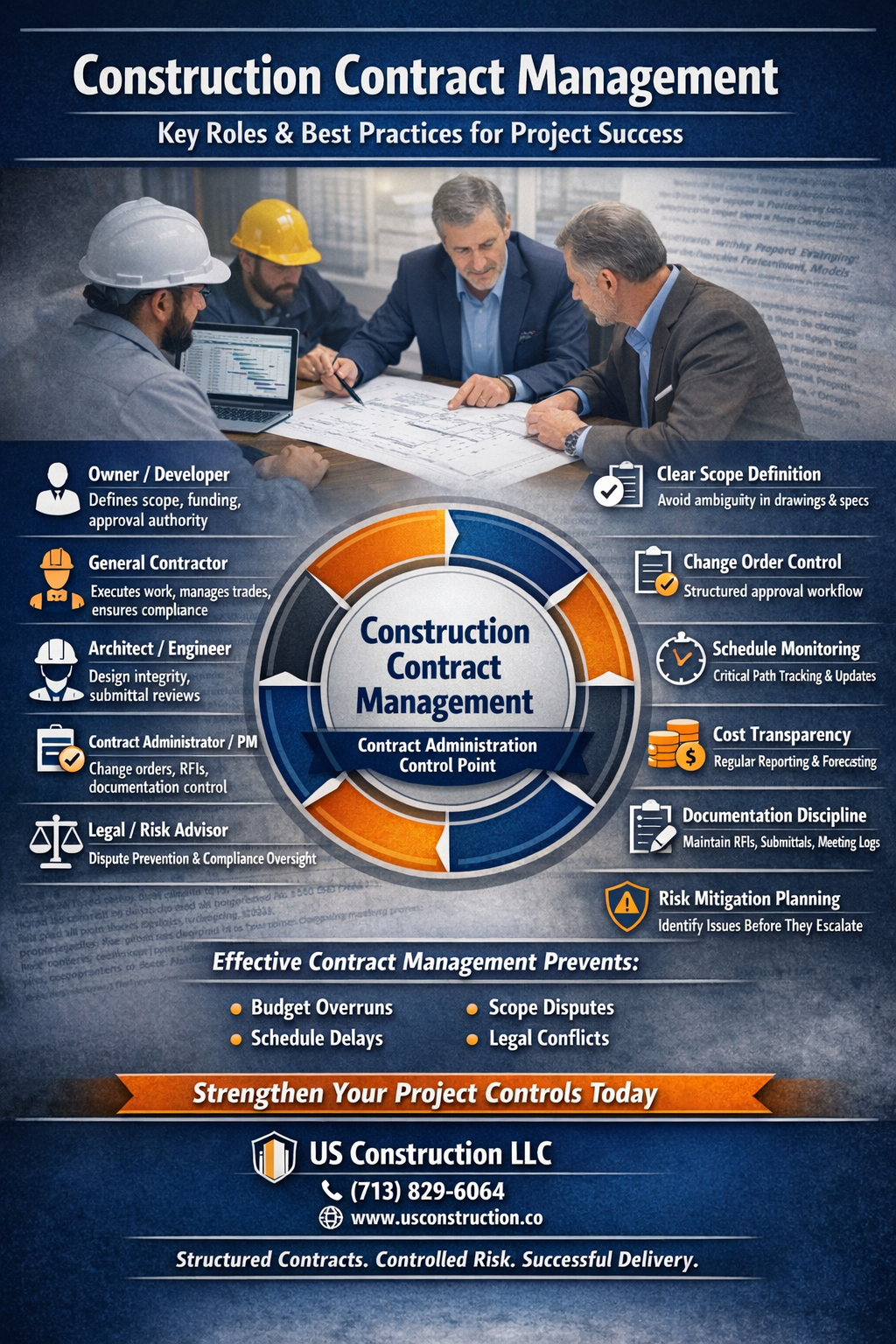
Construction is a high-risk process that involves multi-stakeholders, including property owners, contractors, subcontractors, designers, and suppliers. The construction contracts set the framework for each party. For more understanding, explore construction contract management: key roles and best practices. They are legally bound to meet tight schedules, manage fluctuating costs, and manage risk.
The US Construction LLC company clearly outlines the project scope, timelines, payment terms, and responsibilities to help prevent future disputes. Effective management skills include a comprehensive check of administration, documentation, and enforcement. This blog covers the key roles, responsibilities, and best practices of construction contract management.
Understanding Construction Contracts in Houston, Texas
A construction contract is a precisely structured roadmap of all processes, material specifications, and alternate plans. It is well communicated between all stakeholders for reviews and active involvement. A comprehensive contract covers all clauses for responsibilities, risk allocation, and financial control.
Types of Construction Contracts
General construction companies in Houston, Texas, follow different contractual models depending on the project’s needs and scope. Some frequently adopted frameworks are:
| Lump Sum / Fixed Price | In this contract, the prices are fixed for a specific nature and scale of the project. This strategy protects the owner from financial risks but offers limited flexibility in design features and material selection. |
| Cost Plus / GMP (Guaranteed Maximum Price) | Contractors define an upper limit for expenses beyond which a project will not be completed. If they failed to meet this boundary, they are responsible for paying the excess expenses. The contractor’s fee is separate from this construction cost. |
| Time and Material (T&M) | The owner pays for the actual cost of labor and material, along with the developer’s fee. This approach is suitable when project scopes and designs are not defined. However, the risk of cost overruns is high and requires close monitoring. |
| Design-Build and Integrated Project Delivery (IPD) | Generally, a single body was responsible for the design and construction process. It is a more effective and collaborative strategy for cost control and quality structures. |
Key Elements of Construction Contract
It is a legal document with a standard format. Generally, the contract structure is similar across all project types. Including:
- Project Scope and Specification
Clearly defines the construction objective, the material’s key specifications, and the supply. Moreover, the responsibilities of each party are clearly defined to prevent ambiguity and disputes.
- Deliverables and Milestones
Outlines the project timelines with segmentation of each phase. Completion dates and performance benchmarks are detailed.
- Payment Schedules
Payment terms and milestones with the completion process are explained. Contractors communicate fair invoicing procedures to ensure consistent cash flow.
- Change Order Processes
For precise understanding and management of contractual conditions, a comprehensive change order process is mentioned.
- Legal Clauses
Includes liability provisions to protect both the property owner and the builder. It includes warranties, indemnification, and dispute resolution mechanisms.
Roles and Responsibilities in Construction Contract Management
For better understanding and enforcement of construction contracts, the role and responsibilities of each party should be clearly stated.
Owner / Client
- Defines their preferences, expectations, and performance needs
- Approves the cost estimates, material procurement strategies, and specifications
- Ensures building codes compliance
- Collaborate for timely decisions to prevent delays
The owner is the primary contributor to financial accountability and strategic contractual directions.
Contractor / Builder
- Executes construction operations as decided
- Manages on-site workers, subcontractors, and material suppliers
- Monitor expenses, timeframes, and quality performance
- Regularly submits progress reports
- Compiles invoices and follows change order requests
The contractor is responsible for delivering the project safely, on time, and within agreed financial parameters.
Project Manager / Contract Administrator
- Monitors progress and measures performance metrics
- Complete documentation and reporting
- Oversees order change processes
- Identifies risk factors and mitigates
They serve as the central body for monitoring, reporting, resolving, and following contractual obligations. Project managers ensure delivery of consistent results throughout the project lifecycle.
Subcontractors and Suppliers
- Execute their trade compliance with scope, schedule, and quality standards
- Provide progress updates to the contractor
- Manage regular invoicing
- Comply with safety and regulatory codes
Contractors measure their performance, and they are obliged to meet timelines and overall quality outcomes.
Legal and Compliance Advisors
- Draft and review clauses of the contract
- Contract aligns with local building codes and industry-specific standards
- Allocate best practices for risk mitigation
- Resolve disputes and customer claims
Legal and compliance professionals are responsible for streamlining contractual ambiguities.
Construction Contract Lifecycle Management Step-by-Step
Construction contracts require systematic approaches for effective enforcement and compliance. Houston general contractors follow a structured and organized set of steps for risk control, compliance, and project success.
| 1. | Contract Planning and Risk Assessment |
|
|
| 2. | Drafting and Negotiation |
|
|
| 3. | Execution and Documentation |
|
|
| 4. | Monitoring Performance and Compliance |
|
|
| 5. | Managing Changes and Amendments |
|
|
| 6. | Close out and Final Settlement |
|
|
Best Practices for Construction Contract Management
Implementing structured best practices enables the contractors to identify possible risk factors and strengthen mitigation plans.
-
Clear Scope Definition
Clearly define the scope of work, including a complete breakdown of products and itemized, detailed specifications. Contractors outline the milestones for progress and change order protocols. The clauses of a contract should avoid vague language and assumptions.
-
Document Everything
Keep a record of all proceedings with comprehensive documentation and review channels. Builders integrate digital platforms for approvals, RFIs (Requests for Information), progress reports, and meeting minutes. Effective paperwork provides accountability and reduces the risk of disputes.
-
Open Communication
Establish consistent communication and involvement of the property owner, contractors, and consultants. Houston commercial contracting companies facilitate collaboration among all stakeholders to make informed decisions and prevent misunderstandings.
-
Risk Allocation
Proper buffer budgets and contingency plans are specified to mitigate unexpected risks. To overcome miscommunication and conflicts, the roles and responsibilities of each party are clearly defined. Effective management strategies reduce design errors, delays, and price fluctuations.
-
Performance Monitoring
Track schedule, performance, and quality standards that are previously set as key performance indicators (KPIs). Continuous monitoring enables staff to detect issues early and take corrective action before problems escalate.
-
Dispute Resolution Strategy
Include a structured dispute resolution mechanism with the assistance of legal professionals. Contracts serve as authentic evidence in cases of conflict, to avoid costly litigation and damage to contractors’ reputations.
Technology and Tools in Contract Management
Modern construction businesses are transforming their traditional approaches to digital systems. Effective contract management programs enhance transparency, accountability, and data-driven decision-making.
Construction Management Software
The most reliable management tools are Procore, Buildertrend, and CMiC. These software are accredited and approved for fair record-keeping, financial tracking, scheduling, and communication. Digital channels are a more secure way to manage documentation without administrative risk.
Digital Document Dashboards
Cloud-based management of project proceedings provides a structured, retrievable format for contracts, change orders, submittals, and RFIs. Real-time control of online dashboards enables comprehensive monitoring and tracking. Each stakeholder can access the project budget, spending, pending approvals, and timelines.
Automated Notifications
The concerned authority is automatically notified of the request for information without manual involvement and separate emailing. These fast-track procedures reduce the chances of delays.
Houston General Contractor Near Me
Successful construction projects require complete control over documentation and effective management skills. Construction contracts are formal, legal documents that specify all project parameters.
In today’s complex construction environment, US Construction LLC follows structured approaches for contract management. We are the most experienced general contracting company in Houston, Texas, that proactively mitigates risk factors.
FAQs
Q 1. Who are a contract administrator and a project manager in construction?
A contract administrator is an authorized professional responsible for contractual compliance and documentation. They manage change order procedures, risk mitigation plans, and documentation control.
A project manager is the central body of the project’s administrative staff. They oversee project delivery, schedule coordination, budget tracking, and operational performance.
Q 2. How can construction disputes be managed with contracts?
These are legally approved documents that clearly state all aspects of the project, from planning and budgeting to final execution. Moreover, they have mutually agreed and signed a document after the consent of all stakeholders. It can be used, as evidenced in cases of conflicts or disputes, during and after the construction process.
Q 3. What are the use cases for order change?
Change orders are submitted by the owner to make amendments to the design, material specifications, or to request additional work. They are immediately notified of a modification to the project’s scope, cost, schedule, or design intent.
Q 4. Which contract is suitable for large-scale commercial developments?
Indeed, the selection of a construction contract is based on project complexity and risk tolerance. However, the best types for commercial construction are:
- Guaranteed Maximum Price (GMP) contracts
- Design-Build contract
- Cost-Plus contracts
Leave A Comment